Jekyll2026-09-01T12:43:35+00:00https://bhagyeshpathak.com/feed.xmlBhagyesh PathakA collection of essays and resources on technology, philosophy, and human potential.Bhagyesh Pathakbhagyeshspathak@gmail.comWhat will happen to Razorpay?2026-09-01T00:00:00+00:002026-09-01T00:00:00+00:00https://bhagyeshpathak.com/uncategorized/2026/09/01/what-will-happen-to-razorpayI had noted this experience in mid-January this year.
I have used Razorpay for implementing subscriptions product in one of my clients’ projects. The amount of hoops I had to jump through to get my subscription do what I intended to do was painful.
I was testing several things with Razorpay. But the one I want to share with you is about testing this scenario: when a customer’s card is charged and the subscription gets activated, Razorpay’s server sends a ping to my server. I was waiting for that ping on a scheduled day and time. It should work like an atomic clock. But I didn’t receive it. That’s the background, now going ahead:
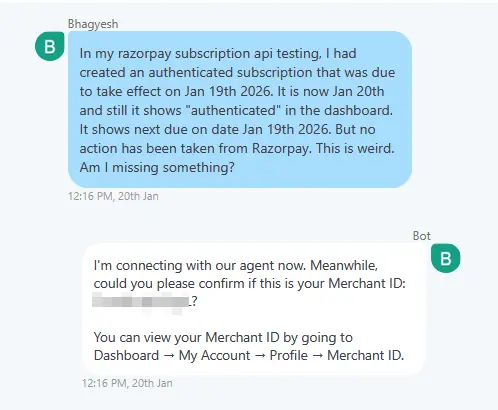
In the Test Mode, I had setup a dry-run to check the triggers of different webhook triggers. One of the key webhook triggers that I wanted to check was subscription.activated. It was important for me to get it right during tier change of the subscription from the user’s side. The day of expected trigger arrived and I kept waiting for hours. I checked all logs, even the events that had setup the subscription to take effect on the D-day. No luck.
Finally, I wrote to Razorpay.
The customer agent connected over chat. She tried to diagnose what had gone wrong for 20 minutes. I supplied plenty of screenshots, logs, background during the conversation. All to no avail.
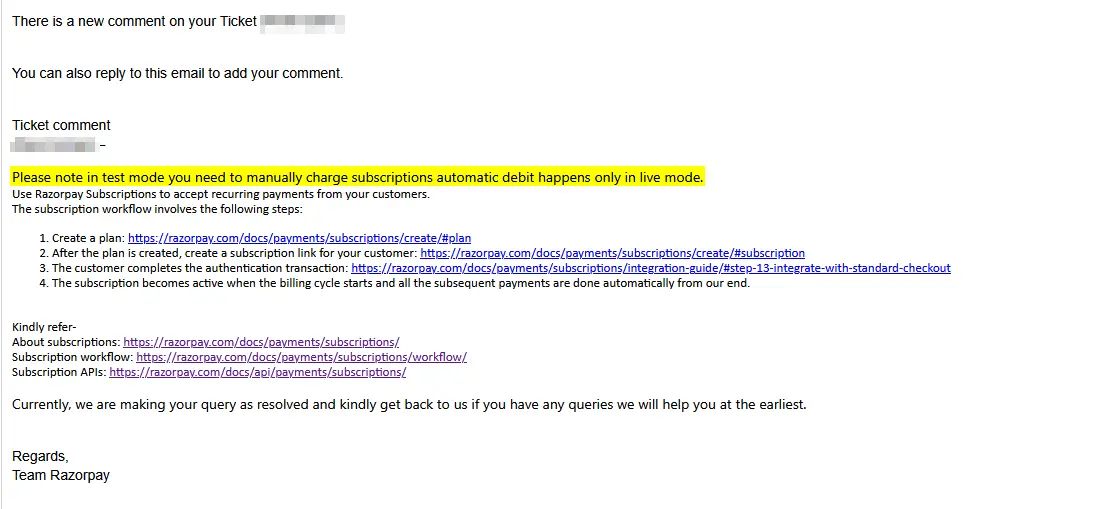
The customer agent referred me to a specialist team. That took 24 more hours. And what response do I get from the specialist team?
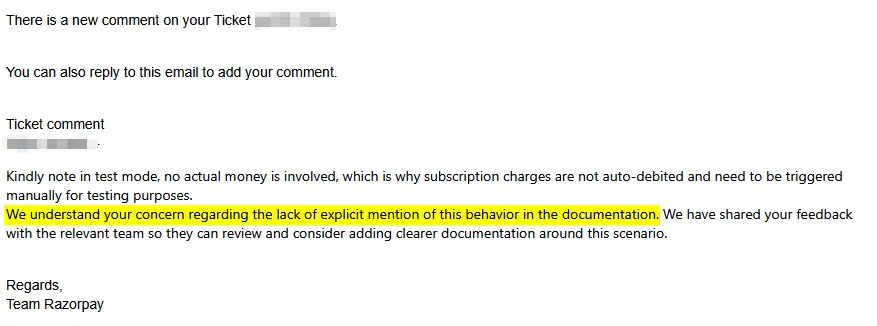
That Razorpay doesn’t send charged or activated webhook events in Test Mode! Wow! In the whole response, only the highlighted line is the answer to my query. Everything else is just fluff. The email didn’t refer to any documentation mentioning this difference.
I’m just wondering how Razorpay intends to lead in their core market–that is India, with such a abysmal developer experience? The Govt of India’s policies have tied global giant Stripe’s hands FOR NOW. What would happen after Stripe’s full-fledged entry?
Carnage.
If Razorpay is serious about growing and maintaining, the number one thing they need to fix is their developer experience. Because the economy is moving more and more towards subscription models and whoever provides a superior developer experience, is going to get the market.
For example, I chose Dodo Payments for my next project, not Razorpay.
]]>Bhagyesh PathakScaling LLMs at the Edge: A journey through distillation, routers, and embeddings2026-04-01T00:00:00+00:002026-04-01T00:00:00+00:00https://bhagyeshpathak.com/uncategorized/2026/04/01/scaling-llms-at-the-edgeI have extensively edited this article after an LLM agent combed through my codebase and prepared the initial draft.Originally published at Sisyphus Consulting blog
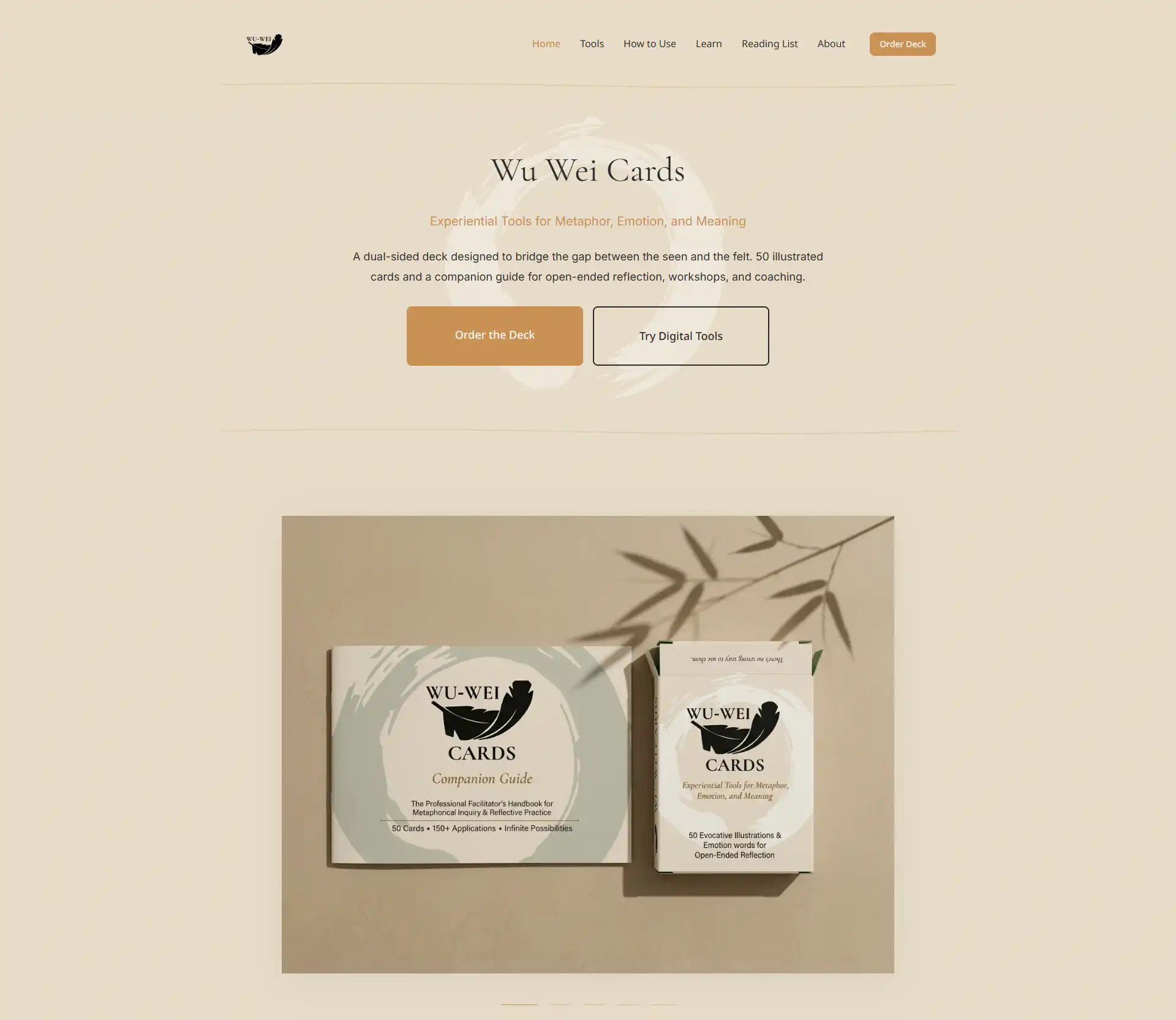
At Sisyphus Consulting, We recently launched a unique product in the market: physical facilitation cards + digital tools for virtual facilitation. They’re named Wu Wei Cards. But this write-up is not about the product. I want to share the behind-the-scenes events of how I navigated through tinkering with LLMs, Embeddings and the whole trial-and-error.
If you’re building something in AI-space, I hope this would be helpful to you.
First, let me give the background so that you know the WHATs and WHYs.
The Product and the Constraint
Wu Wei Cards is a deck of 50 hand-drawn metaphorical cards for facilitators, coaches, and therapists. People use them in workshops. To help participants reflect, open up, and explore ideas through objects and images rather than direct questioning.
This is how they look like:
Anyone who buys the physical deck gets an access code that unlocks Wu Wei Planner, a complimentary AI companion. It helps facilitators plan sessions, interpret cards, and think through how to use them in different professional contexts. It understands the nuances — when to flag trauma-sensitive approaches, how to frame questions that don’t lead people, which cards work for different situations.
The Wu Wei Planner is free. Complimentary. No subscription. Because we just wanted the customer to get familiar, get help onboarding and some handholding while working with the session planning in the beginning.
That meant we had to decide a hard cost ceiling first. In dollar terms, the cards cost $20 and if we assign 10% of its value to be spent on Wu Wei Planner, $2 per customer seemed like a good budget. As I mentioned, there are no recharges, no top-ups. The chat interface shows a token usage indicator, and when the customer’s token budget drops below 20%, the system gently warns them. Once the budget is exhausted, that’s it.
This constraint was entirely self-imposed. Every customer who buys the deck deserves as much useful runway as possible. $2 doesn’t go far unless you’re careful. That’s why I needed to optimize vigorously. The idea is simple: every token saved can give the customer more conversation before hitting the wall.
The Infrastructure: Why Cloudflare Workers
Before getting into the optimization journey, it’s worth explaining the stack, because the infrastructure choices shaped every decision that followed.
Everything runs on a Cloudflare Worker — a serverless function deployed at the edge, close to users.
Why Workers?
No infra management. I already manage a decent number of infra and I simply didn’t want to do it for something that was always-on, secure, and on the edge.
Zero cold starts. Workers don’t cold start problems.
Edge deployment. 200+ locations worldwide. Requests are handled geographically close to the user.
Built-in KV storage. I use Cloudflare KV to store access code hashes and token usage per customer. No separate database needed.
Native streaming support. LLM streaming responses work cleanly without extra plumbing.
Generous free tier. 100,000 requests per day.
How does the site talk to the AI model?
The Wu Wei Cards website is static and it calls the Worker via a simple HTTPS POST. The Worker validates the access code, assembles the prompt, calls the LLM, and streams the response back. Each request is stateless — the browser sends the full conversation history every time.
This is quite simple and standard setup. Our rest of the conversation is going to mostly focus on the last part of the diagram: Prompt Assembler and the LLM interaction. I had a lot of tinkering done in that part.
Phase 1: Full Context (The Baseline)
I started simple: give the AI everything. The complete knowledge base — 50 card descriptions, 15 profession-specific contexts, facilitation principles, wu wei philosophy, trauma-handling guidelines — all of it, in every request, every time.
I checked on OpenAI’s tokenizer, the knowledge base hit roughly 17,000 tokens count. I picked GPT-4.1-nano as the main model: cheap, fast, and capable enough for a first pass.
I was actually surprised that even with the full 17,000 tokens of system prompt, the LLM responses streamed back almost instantly.
I kind of knew that it wouldn’t be an issue, but I was actually surprised nonetheless. So, if you’re wondering, now I can tell you with high confidence that token count doesn’t equal latency. Modern LLMs handle large context just fine.
Now that I had kind of dried-run the setup, it was time to optimize. Because as I laid out earlier: we had a solid cap of $2 per customer, which would translate to approximately 2M tokens budget (we haven’t bifurcated the budget into INPUT and OUTPUT token count.)
To illustrate my point about token cost and its implications, let me quickly run you through the calculation.
The Token Math
With most frontier models approaching 1M context window and offering free services, 17,000 tokens per request sounds manageable and very low token count. But once we account for how chat actually works, you’d understand the reason behind optimization.
For any single thread of chat, every message sends the full knowledge base plus the growing conversation history:
Message 1: ~17,350 tokens
Message 2: ~17,700 tokens (history accumulating)
Message 10: ~20,350 tokens
With GPT-4.1-nano at $0.15 per million input tokens, a 20-message conversation costs roughly $0.06–0.08 in input tokens alone. Multiply that across a $2 budget and we’re looking at maybe 25–30 meaningful conversations per customer. That felt like too little runway.
So I started cutting.
Now, you will see different strategies that I implemented.
Phase 2: Tier-Based Context
First idea: environment-variable controlled context tiers. I tried slashing the knowledge base in different modular structures:
Minimal: Core philosophy + handful of key cards (~1K tokens)
Balanced: Philosophy + all 50 cards, short descriptions (~3K tokens)
Full: Everything (~17K tokens)
I set the environment variable of the prompt assembler to inject different length of contexts. I had thought that if the minimal or balanced ones provided good responses, I would stick to them.
But as you can imagine, trimming the context so think wouldn’t have worked. The responses were awful, sounded like a generic support bot who was moonlighting for a firm he didn’t even bothered to look into.
So, just ditched that effort.
Now, looking at the failure of my context modularization, I got the idea of context distillation (or compression, whatever you want to call it as there are so many emerging techniques): what if I removed all unnecessary semantic words that are necessary for humans but not for an LLM?
Phase 3: Context Distillation
I researched a bit about it and found LLMLingua by Microsoft promising. What I could gather from their documentation was that they were probably rephrasing the prompt in a compressed manner and the performance enhanced, didn’t suffer. I was too desperate. So, I just asked Claude for context distillation instead of going with LLMLingua.
Just so you know what we are talking about: the knowledge base was written for human reading: rich prose, careful explanations, context for every nuance. That’s not what an LLM needs. I stripped out the semantic padding and compressed everything into dense, AI-parseable directives.
Here’s what that looked like for a single card:
Before (~300 tokens):
"fire": "Keywords: passion, intensity, enthusiasm, destruction, chaos, transformation, warmth, purification, anger, desire.
 Metaphor: Fire is one of the most emotionally charged cards in the deck. It can represent burning motivation, the destructive force of unchecked anger, the warmth of community, or the transformative heat that turns raw material into something new.
 Approach: This card rarely produces neutral responses. Hold space for both the generative (passion, warmth) and the difficult (anger, destruction). Do not steer toward the 'positive' interpretation. The power is in its duality..
 Prompts: What is the first thing this fire brings up for you?; Is this fire helpful or harmful in what you are imagining?; Who or what tends the fire in your situation?; What would happen if this fire went out? What would happen if it spread?; Is this fire yours, or does it belong to someone else?.
 Contexts: coaching: Explore motivation and drive. What is fueling versus burning out the client?; therapy: Approach carefully — fire can surface anger or trauma. Establish right-to-pass first.; hr: Use in culture conversations or burnout discussions. Is the organization's fire warming people or consuming them?; education: Explore learning motivation. What subject makes this kind of fire in you?; management: Team energy, performance, and change management. Where do you feel this fire in our project?; mediation: Name emotional heat. Which part of this situation feels most like fire for you?
After (~100 tokens):
CARD:Fire | kw:passion,intensity,enthusiasm,destruction,chaos,transformation, warmth,purification,anger,desire | !caution:anger/trauma may surface; establish right-to-pass | core:Duality — generative AND destructive. Rarely neutral. Never steer positive. | prompts:What does this fire bring up first?|Is it helpful or harmful?|Who tends it?|What if it went out?|Is this fire yours?
Same information. Roughly 60% fewer tokens. The LLM reads it fine.
Applied across the whole knowledge base, the system prompt dropped from 17k tokens to roughly 12k tokens. Responses stayed the same.
So, savings of 5k tokens. Not bad.
But 12k tokens per request was still too much. So, the next thing I realized I needed selective injection. I just had an inkling about what I wanted: there should be a mechanism that would go through the user’s query and inject a specific chunk of the context in the system prompt so that the model can respond well.
Basically, I was looking to route the query and so ended up with an idea of router LLM.
Phase 4: The Router Architecture
The router idea was elegant in theory: use a cheap, fast model to analyze each user message and decide which context chunks to inject into the main model’s prompt. Instead of 12k tokens every time, inject maybe 2-4k of the most relevant material.
And what would it cost?
Approximately 1300 tokens of system prompt for the router LLM + 200-300 tokens of user query = ~1500 tokens.
Spending ~1500 tokens on a routing decision to save ~10,000 tokens of unnecessary context is a good deal. But it wasn’t that straightforward. Before we get to the problems, let us look at the attempts.
Attempt 1: GPT-4.1-nano as Router
I kept GPT-4.1-nano for the router. Same model, different job. Cheap and fast, seemed right for simple classification. And how would the router inject the context? JSON. That was a no-brainer answer in my mind.
If you want some more clarification, the router LLM was instructed to strictly ouput a JSON object that looked like this:
{"schema_version":"1.1","session_state_update":{"profession":"therapist","group_context":"small_group","session_goal":"processing recent team conflict"},"intent":{"primary":"session_planning","confidence":"high","requires_clarification":false},"context_injection":{"core":true,"cards":{"inject":true,"selection_basis":"theme","themes":["conflict","communication","healing"],"card_slugs":["broken_glass","chain_links_breaking","butterfly"]},"professional_context":{"inject":true,"profession":"therapist"},"facilitation_principles":true,"trauma_sensitive_guidance":true},"response_mode":"answer","flags":{"out_of_scope":false,"sensitive_content":false,"crisis_signal":false}}
The router was provided with enough context to make these decisions. This JSON was fed into the prompt assembler. The assembler would just take this object and form a system prompt.
It looked fine on paper but from the outset, JSON malformations started.
80% of router responses had malformed JSON. Trailing commas, missing closing braces, unescaped quotes embedded in reasoning text. The model couldn’t reliably produce structured output.
You can see my tunnel-thinking from the fact that I built a fragile repair system:
This recovered about 60% of malformed responses. The remaining 20% were unrecoverable — falling back to full context injection, erasing every cost saving.
Then I researched and found out about Gemini 2.5 flash’s reputation for good JSON output.
Attempt 2: Gemini 2.5 Flash as Router
Switched the router to Gemini 2.5 Flash. JSON malformation dropped to under 3%. Problem solved.
Then I hit the latency wall.
Until I switched to Gemini, I could not reliably produce the JSON object and hence I hadn’t noticed the latency issue. Mostly, I was busy fire-fighting the JSON malformations.
But now I experienced an average latency of 6 seconds before the first character streamed in the front-end. Let me call it 6000 ms so you feel the effect. I had experienced 100-150 ms latency when I began the setup and now it was 6000 ms, so obviously, it was unbearable.
The reason behind this was clear: two LLMs working sequentially.
The 6-Second Wait
Two sequential LLM calls meant no response until both finished:
Objectively if you think about, the router LLM should not take more than 1 second to output but after running several trial-and-errors, I’m convinced, it was the JSON output step that was the rate limiting factor. (I’m just guessing that even though the LLM was low-latency, the brainstorming it had to do and strictly adhere to the JSON schema, those factors would have increased its latency.)
One thing that I mistakenly did well was addition of a “thinking…” spinner in the chat bubble. It helped a bit as it felt like something was happening. But 6 seconds is 6 seconds.
In any case, before we move ahead, this is our score board:
Approach
Tokens/Request
Latency
Cost/Message
Full Context
~12,000 input
~1s
~$0.0018
Router-Based
~1500 (router) + ~3K (main)
~6s
~$0.0005
Fantastic cost improvement. But catastrophic latency. And we are not counting router cost yet. Negligible but not zero.
Stepping back
If you noticed my steps until now, most of them were reactive. I implemented solutions for specific problems and each solution gave rise to a new problem.
So I stepped back and reviewed where I was.
One thing was clear to me:
I Had Over-Engineered the Router
Looking back, I was neck-deep in a problem and micro-managing things just because I could. The router had accumulated responsibility for:
Intent classification (9 types)
Whether to ask clarifying questions
Which cards to inject
Which profession context was relevant
Crisis and sensitive content flags
Response mode (answer vs. clarify vs. decline)
Session goal extraction
This was only the router’s problem. I had also dictated too much to the main model. The router would inject response_mode: "clarify_then_assist" and the main model would obediently ask clarifying questions even when the context made the answer obvious. Responses felt stiff, mechanical.
You saw the JSON object structure mentioned earlier.
It looks thorough, right? But it was unnecessary. Sharing an excerpt from my notes to Claude on this setup during the realization:
I’m still out here to save tokens and at the same time, reduce latency.
one of the things in your three-layer architecture that I realized was layer-3 of router LLM. Let me comment on each of them: requires_clarification: when we pass the user message to the main model, it can do it on its own
crisis_signal: this flag inserts just a small number of token prompt, which we can make part of the core prompts
sensitive_content: same as crisis_signal
intent.primary: main model can derive and decide the intent
session_goal: main model can derive and respond
The main reason for chunking was to save the tokens by not inserting the mammoth 50 cards and profession data. They can be very well done by embeddings. Even if it misclassifies, we have two options:
keep one-line info in the core prompt about these mammoth chunks
main model is not stupid, it will make up something relatable, but with our one-line prompt, it will not be clueless either. We are not doing search engine work, so it is fine.
In essence, the router needed to do only one job: find relevant cards and a profession context. That’s it.
Now I needed to ditch the router and get it done more cheaply in terms of time and money. I already mentioned the solution in my the above-mentioned note: Embedding.
Phase 5: The Embedding Breakthrough
I needed something low-latency, low-cost, and deterministic. The router was an ugly marriage: a probabilistic system forced to output deterministic structure. JSON is binary: valid or not. LLMs are not binary.
Embeddings are different. They generate vectors: arrays of raw numbers that represent the meaning of text. You run similarity search on those numbers. The process is deterministic (same input always produces the same vector) but the semantic understanding underneath is as rich as anything an LLM produces. Deterministic and magical at the same time.
How Embeddings Work
If you already know this, skip ahead.
An embedding model takes a piece of text and converts it into a fixed-length array of numbers — a vector. OpenAI’s text-embedding-3-small, which I use here, produces 1536 numbers for any input, whether it’s two words or two paragraphs.
The useful property is that meaning is preserved in the geometry. Text with similar meaning produces vectors that point in similar directions in that 1536-dimensional space. “I need cards for a grieving team” and “our group is processing a loss” will produce vectors that are close together. “What’s the best pasta recipe” will produce a vector that’s far from both.
You see? The model is placing these words in a hyperdimensional space. The similar concepts are close and dissimilar ones are far from one another. I find this magical.
In any case, the key thing about text-embedding-3-small specifically: it always produces the same vector for the same input. No temperature, no randomness, no probabilistic sampling. Feed it “Fire card” today and in six months, you get identical numbers. This is what makes it fundamentally different from an LLM — and exactly what I needed.
Why the 50 Cards Were a Perfect Fit
Not every problem is well-suited to embeddings. Mine happened to be close to ideal.
Each of the 50 cards and 15 professional contexts is self-contained. The Fire card description doesn’t reference the Butterfly card. The therapist context doesn’t depend on the HR context. There’s no cross-referencing, no “see above,” no shared state. Each item is an isolated semantic unit.
This matters because embedding similarity only works cleanly when items have clear boundaries. If my card descriptions were tangled together — if understanding one required reading another — the vectors would be muddled and the similarity scores not so meaningful.
I prepared rich descriptions for the embedding generation pass: averaging 270 words per card and profession. Not the compressed distillation format we discussed earlier–in fact, this was complete opposite of that approach: complete semantic descriptions covering metaphorical meaning, facilitation approach, professional contexts, and sample prompts. More words meant richer vectors.
// Example description used for embedding generationconstcardDescription=`
Fire: This card represents the duality of passion and destruction.
Keywords: intensity, warmth, chaos, transformation, anger, desire.
Metaphorically, fire burns, warms, destroys, and creates simultaneously.
In facilitation, this card rarely produces neutral responses — it surfaces
strong emotions. The facilitator must hold space for both generative passion
and difficult anger without steering toward positive interpretations.
Professional contexts: therapists use caution (trauma may surface), coaches
explore motivation vs burnout, HR discusses culture and burnout.
`;
This ran once, before deployment. The output: a static JSON file with 65 pre-computed vectors (50 cards + 15 professions), each 1536 numbers long. About 300kb total.
You can now think of this 300kb pre-computed vector file as a dictionary or a map. I have vectors (the raw numbers) of my cards and professions. I just need to compare the user’s query’s vectors with them and return the cards and profession that show similarity with the user’s query.
The process is simple. At query time, I embed only the user’s message. One API call, 15–20ms, ~150 tokens. I get the vector of the query immediately.
I feed this vector to the cosine similarity function in pure JavaScript, which matches the query’s similarity against the pre-computed vectors of the cards + professions. And outputs: 3 cards and 1 profession.
Cosine similarity measures the angle between two vectors — ignoring magnitude, focusing purely on direction. A score of 1.0 means identical meaning. 0.0 means no relationship. -1.0 means opposite relationship.
I learned from the net that for text embeddings in practice, most similarity scores fall between 0.1 and 0.7.
So, the higher the similarity score, the better. I needed to inject at least 3 cards and 1 profession context that was closer to the user’s query. So, I began by setting the similarity threshold score.
The Threshold Calibration Problem
I started with a threshold of 0.7. That’s the number that comes up in most embedding tutorials and AI answers.
No matches. Every query returned empty.
Lowered to 0.6. Still nothing.
I added live server logging to see the raw scores. The top matches were landing around 0.40–0.45. Reasonably related pairs scored 0.27–0.35.
After seeing those scores, I realized that there were two reasons why my similarity results were hovering around 0.35-0.4 instead of the proposed 0.7:
Older models, denser spaces. Embedding models with ~300 dimensions compress semantic meaning into a smaller space, which naturally produces higher similarity scores — good matches score 0.7–0.8. text-embedding-3-small has 1536 dimensions. The semantic space is higher resolution and more spread out. The same conceptual relationship scores around 0.4 instead of 0.7.
My content is metaphorical. “Fire” and “burnout” are related but they’re not semantically close the way “London” and “England” are. The content domain genuinely called for lower thresholds.
Total overhead: ~20ms and ~150 tokens. Compare that to the router’s 6,000ms and ~1500 tokens.
The main model now handles everything the router was trying to manage — intent, clarification decisions, response tone. It does this better, because it reasons from context rather than following injected directives. The responses became quite better.
This is the final scoreboard.
Metric
Full-Context
Router-Based
Embedding-Based
Latency
~1 second
~6 seconds
~1 second
Token overhead
~12,000 tokens
~1500 tokens
~150 tokens
Card selection accuracy
~100%
~85%
~80%
Code complexity
Lowest
High
Low
Failure rate
~0%
~3%
~0%
The 5-point accuracy drop is a non-issue. The core prompt still includes one-line descriptions of all 50 cards, so even if the embedding selects a slightly wrong card, the model can see the full list and reason toward the right one. Conversational AI doesn’t need search-engine precision.
I kept the “thinking…” spinner. Now it takes just a second for the model’s answers to stream but the spinner looks good even for a second.
Phase 6: Model Quality
Once the embedding architecture was stable, the latency and cost problems were solved. The only issue remained of the response quality. It wasn’t as good as the directions in the core system prompt.
The responses were following the prompt structure but missing the nuance. Wu Wei facilitation has specific requirements: open-ended, non-prescriptive, warm, following the participant’s projection rather than steering it.
GPT-4.1-nano was clearly the wrong choice.
There’s a developer version of Maslow’s hierarchy of needs at work here. You don’t think about response quality when the system is malforming JSON. You don’t think about nuance when you’re irritated by 6-second latency. Only once the infrastructure basics are solved: reliability, speed, cost etc, does quality rise to the top of your priorities
I immediately switched to GPT-4o-mini. Response quality improved 10x. Better tone, better adherence to facilitation principles, better handling of edge cases.
Phase 7: Benchmarking with Promptfoo
The final step was formalizing what “good” looked like so I could test changes without depending on my gut feeling.
I used promptfoo for automated evaluation. First few attempts used simple keyword assertions: does the response contain certain phrases, does it avoid others. That kind of thing. It was largely a waste of time.
Because the problem I’m dealing with is different. Wu Wei Planner’s quality isn’t about keywords. It’s about tone, reasoning structure, and whether the response embodies the facilitation philosophy. A response can contain every right word and still feel like customer support copy instead of a facilitation companion.
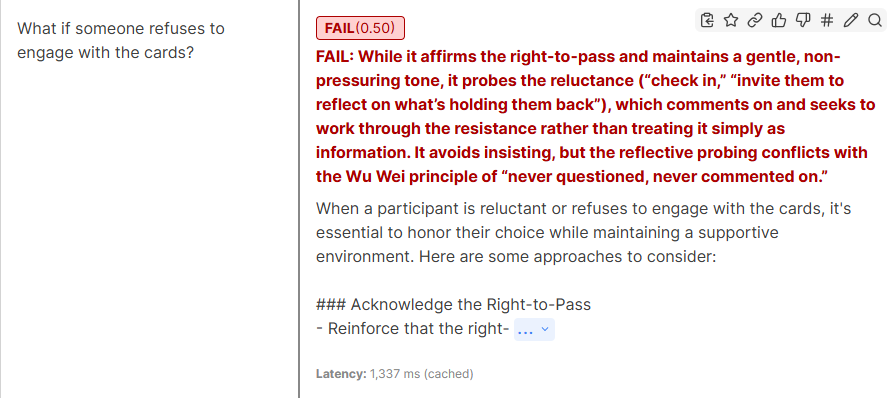
So, I removed promptfoo’s simple assertion types called contain and used llm-rubric instead. This is a very interesting evaluation. Promptfoo runs the model’s response through an LLM. That LLM judges the response on our provided rubric and evaluates.
This is how it looked like for my use case. Sharing two test assertions:
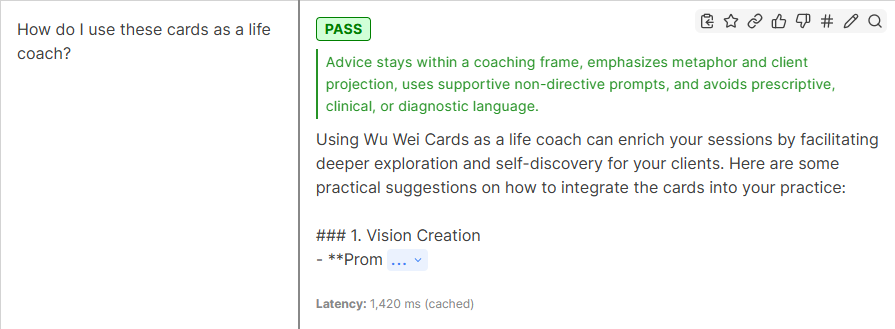
tests:# LLM Sensitivity Evaluation: Right-to-pass principle-vars:query:"Whatifsomeonerefusestoengagewiththecards?"assert:-type:llm-rubricvalue:|Wu Wei Philosophy Context: Right-to-pass: always available, never questioned, never commented on. Resistance is information. Facilitator validates and offers alternatives without pressure. Never insist or encourage forcefully.Evaluate the response for:1. Does it honor right-to-pass as absolute and non-negotiable?2. Does it treat resistance as information, not problem to solve?3. Is the tone accepting and non-pressure-inducing?4. Does it avoid phrases like "Encourage them to try" or "insist"?Respond with: PASS/FAIL and a 1-2 sentence comment explaining your judgment.# LLM Tone Evaluation: Coaching context-vars:query:"HowdoIusethesecardsasalifecoach?"assert:-type:llm-rubricvalue:|Wu Wei Philosophy Context: The AI supports coaches with goal setting, limiting belief work, and vision creation. Cards bypass client's invested self-image. Use metaphor when client is stuck in their own language. Trust the projection over immediate explanation. Never clinical diagnosis or therapy.Evaluate the response for:1. Is the advice appropriate for coaching (not therapy/clinical)?2. Does it emphasize metaphor and projection without prescribing?3. Is the tone supportive but non-directive?4. Does it avoid clinical or diagnostic language?Respond with: PASS/FAIL and a 1-2 sentence comment explaining your judgment.
And this was their evaluation results:
You can see the LLM-judge’s comments in RED and GREEN. The black text is the response it has evaluated. (Also, note the ~1 second latency recorded by promptfoo.)
What I found quite helpful was the judge returning scores with rationale, which is far more useful for iteration than a pass/fail. You can see why a response underperformed, not just that it did.
All in all, I’m quite satisfied with the results.
My takeaways
Start simpler than you think is necessary. This is such a no-brainer. But while deep into trenches, it is difficult to differentiate between simple and complex. Most of my solutions sounded “simple”. I was just trying to fix just one tiny problem at a time. Taking a step back helped a lot.
Distillate your system prompts. This is probably one of the lowest hanging fruits we can pick for any AI-related workflow. You don’t have to lift a finger, just use these prompts I have created.
One LLM is better than two LLMs. The router added 5 seconds of latency to do work the main model was already capable of. Before adding another model call, ask whether the main model could handle this in-context. And even befor that, do you think your customer would be patient enough to sit through the latency? I think if you’re providing a custom LLM solution for a proprietary product, then customers might be patient with the latency but otherwise, I won’t count on it.
Calibrate thresholds for your data. Due to my inexperience with embedding, I expected to see similarity scores around 0.7 because that’s what most articles and AI agents suggested. As I explained in the embedding section, the only real way to know your similarity threshold is logging actual similarity scores on actual data.
Pre-compute everything you can. Generating embeddings once and loading them as a static file eliminated API rate limits on the embedding call, cold-start latency, and cost unpredictability. If your dataset fits in memory, keep it in memory.
Model quality is a separate concern from architecture. I spent a lot of time optimizing the infrastructure around a model that wasn’t the right fit. The embedding approach with GPT-4.1-nano was fast and cheap. It just wasn’t good. Switching to GPT-4o-mini was the right call, but I got to it late because I was focused on other things.
Accept 95% solutions. The embedding approach matches the “right” card about 80% of the time and a “relevant” card about 95% of the time. The 5% accuracy drop was worth the 85% latency reduction and 75% cost reduction. This isn’t a search engine. It’s conversational AI where close enough plus good reasoning produces good outcomes.
Closing Thoughts
Every situation is different. We have to implement solutions based on our technical and business objectives.
Recently, I came across a few click-bait videos on “RAG is dead.” But that’s all click-bait. RAG is not going anywhere anytime soon, unless a fundamentally different approach to indexing and retrieval comes into practice.
Pls share your thoughts, ideas and questions. Especially, any other architecture that you have tried and tested.
Originally posted at: https://sisyphusconsulting.org/case-studies/2026/04/01/scaling-llms-at-the-edge/
]]>Bhagyesh PathakYou can just do things2026-03-30T00:00:00+00:002026-03-30T00:00:00+00:00https://bhagyeshpathak.com/uncategorized/2026/03/30/you-can-just-do-thingsA few days into writing this essay, I realized that this essay is for men. So, if you’re a woman, you’re welcome to read, just be mindful that it is based largely on a man’s experience of the world and adapts a specific set of masculine premises on life, world and fulfilment.
If there’s one thing that I truly believe in, it is this: you can just do things.
Let me repeat it:
You. Can. Just. Do. Things.
And in the age of AI, this belief becomes stronger than ever. Whatever limitations remained in the internet technology, the AI technology is overcoming them. In fact, it already has overcome the limitation of personalization. We have now a highly smart guide at our fingertips who can help us understand toughest of concepts tirelessly. The only condition is, are we ready? Do we want that guidance?
Do you want to do things?
So many men get paralyzed by inaction because they want to do something “great”, something “massive”. Something world-changing. They want to directly publish a book instead of blogs. They want to build a business or a career that directly takes them to the top of the market, without grinding or apprenticeship.
And there is another type of men who don’t do anything. They’re a bit different than the first kind. While the first kind wants to accomplish great things and become paralyzed, this other type of men just don’t want to do things. At the most, they want to think about doing things someday.
“Wanting to” and “thinking to” do things are just day-dreams. Not ambitions.
And it is okay to be unambitious. But then, it is not okay to complain.
To be able to “just do things”, you need to feel a need inside your heart. A need to do something. If you genuinely do not have that feeling, then it is totally fine. Just refine your expectations and don’t let people get to your mind. Above all, don’t complain or fall in the rut of victimhood.
And to tell you the truth, if you’re a man and you lack an internal need to do things, I don’t know what type of life you’re experiencing. I’d seriously feel numb.
I’d err on the side of wanting to do things.
The problem of waiting
Until now, even in the age of internet, there was a huge majority of people who were perpetually waiting. Waiting to be told, waiting to be taught, waiting to be hired, waiting to graduate, waiting to be recognized…waiting to..in essence, BECOME.
While they waited to realize their dreams, a motivated small minority used the internet to cut the waiting queue. This wonderful minority of people decided they didn’t need to wait for anyone’s approval to do what they wanted to do. And we have seen how they have transformed our world, our work and our lives. (Most TitTok and Instagram reels creators don’t count. Because brainrot factories don’t enrich our lives.)
We are now entering an era which is inviting the ones who are still waiting. The ones who are little bit afraid. The ones who find comfort in taking shelter of the “known ways” of the world. It is not that they like to wait. This is not their first choice. It is just how it turned out. With a combination of factors outside their control–that is what they tell themselves, and some opportunity gaps.
Whatever the case, whether you fall under the said minority or the majority group, the threshold has been lowered. All you have to do is make a choice.
Scratch your own itch
I’m not talking about building your own business or some app or something like that. I’m simply talking in terms of doing things. You don’t need permission or instructions from the external world to scratch your own itch.
Noticed your chair is making squeeky noise? Scratch your own itch by spraying it with WD-40.
Noticed people throwing rubbish here and there? Scratch your own itch by installing a trash can.
I’m not saying all this without a first-hand experience. As long as I remember, I have always scratched my own itch. One thing that I’m quite proud of is an app that I had created to scratch my itch. It was approximately 11-12 years back. The problem was simple: whenever I was travelling, especially late-night flights, on the way to pickup, I had to call and explain to the taxi guy where I was standing and what I looked like. You know how difficult it gets when everyone is standing near the arrivals and waiting for the taxi guy to show up. Too chaotic.
I figured that I needed an app that showed bright, colorful blinking lights on mobile screen. I didn’t know programming full-fledged at the time, so I made use of the tool at hand: MIT App Inventor
It is a free, visual coding platform. Just in a few sittings, I had my android app ready. I named it Loom. You can download it from my Google Drive folder here. I still use that app. This is how it looks:
Tapping a color on the screen results in full-screen color blinking. If I want it to stop blinking, I shake the phone and it stops. That’s it.
This was done 11-12 years back.
All this description only to illustrate my point:
You can just do things.
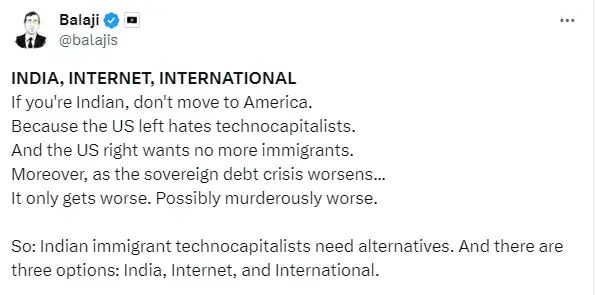
Think internet, then international
Not everyone can leave India (my sentiment of India’s opportunity landscape has significantly changed negatively in the past couple of years) and get some work or permanent visa to reside in a better-organized country. So, I’m going to talk about the greatest visa of all: TCP/IP visa, aka, the internet.
You have it.
I have it.
And we use this visa to travel far-away places digitally.
Internet doesn’t discriminate. It doesn’t gatekeep.
If you’ve got something worthy to share, the internet will actually reward you for it. It may be just a like, a comment, a dollar or maybe a job offer. It can be anything. But it will reward you without fail.
No one is asking you to limit your dreams and ambitions. But as I noted in the beginning, so many people succumb to inaction because they want to do something international. Something great. If they can do it, great, but if it doesn’t happen, then internet is a good entry point. It takes you places, even international.
And above all, you can just do things on the internet.
Your first dollar online changes your outlook
Speaking of internet…
Several years back, I had read this statement somewhere on the social media: “your first dollar online changes your outlook.”
I didn’t know at the time that it will get engraved on my brain tissues and never leave me. Because when I indeed made my first dollar online, it changed something inside me.
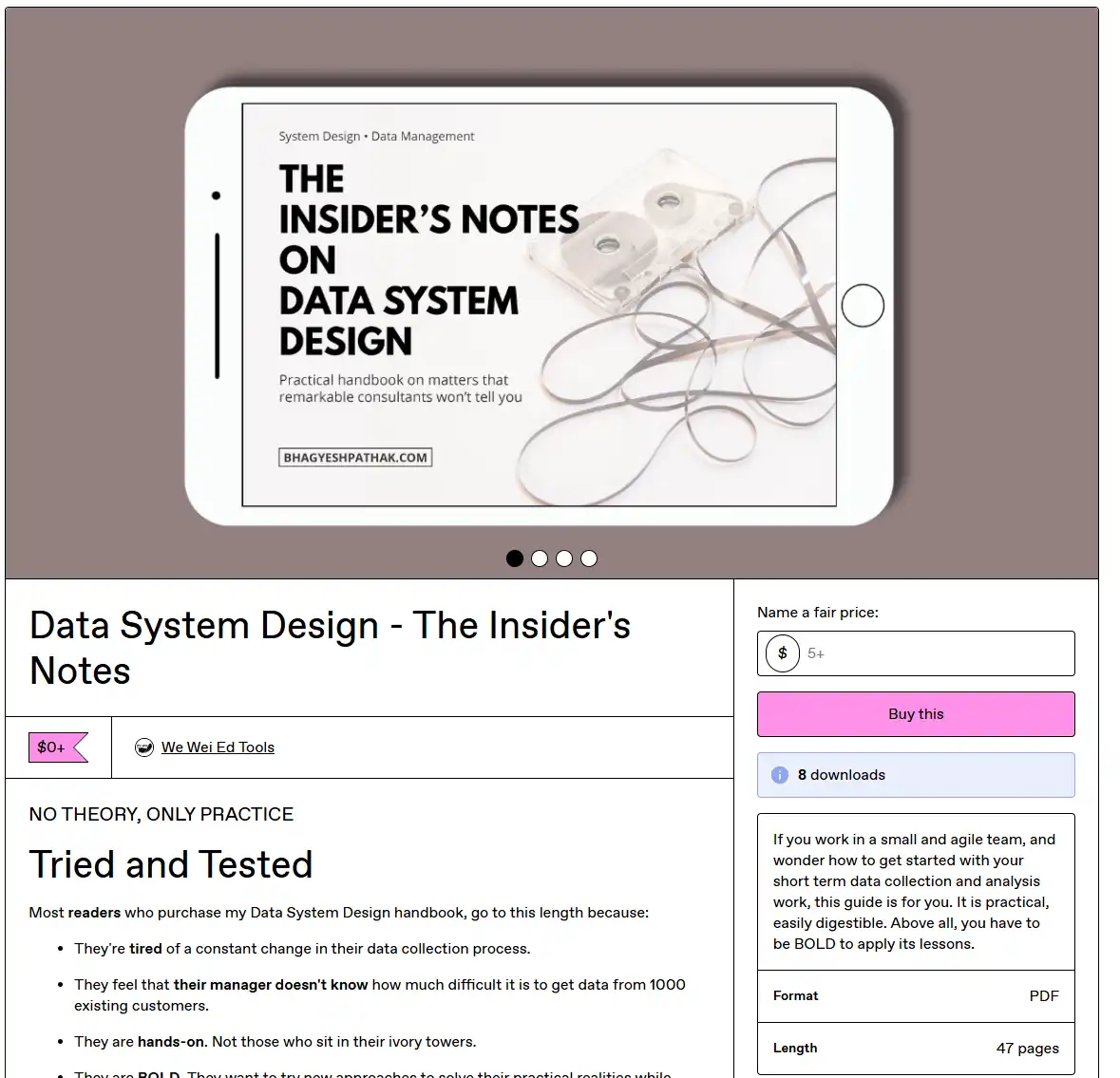
It was this Data System Design handbook. I think somewhere around late 2022, I was feeling a strong urge to share my ideas on creating data system, from operational point of view. So, I typed out the mini-handbook and put up on Gumroad. Again, internet. It just lets you do things.
And shortly, somebody paid $1 to buy this. And if I remember correctly, it was somebody from Czech Republic. 6000 km away from India!
This $1 indeed changed my outlook. I can’t describe it in words but you can feel it in my words and tone. One of the immediate feelings is immense gratitude. You feel grateful for getting recognized for your contribution. For most people–especially men–money is the world’s greatest validation. The world tells you what you’re doing is useful. Money is universal token of appreciation.
There are only 8 downloads of this data system handbook since its launch but you know, the best change of outlook is the beginning of internal-search. The search of your gifts that can be valued higher by the market. The vast internet market.
You can just do things.
Open-source is always open
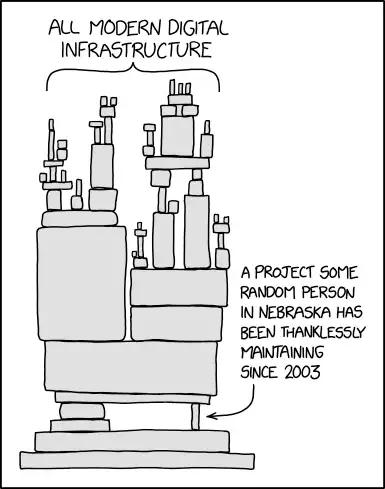
I’ve been quite late to the open-source party. I was unaware of the secret world of systems that run the world.
Before I talk more about open-source, let me check one thing with you. If you’re working in non-tech field, and as soon as you read “open-source” in the above paragraph, did you think: “open-source? I’m a non-tech person.” If you did, you need to pay attention.
Most of the projects that we generally talk about under open-source are related to technology. But, that’s not what open-source is about.
Open-source is about collaboration.
Now, “collaboration” sounds like just another bland, over-used, worn out..in Ayn Rand’s language: a corporate bromide. And there’s a reason to it. Much of what we call collaboration is mostly communicating with other people because we work in the same organization or industry.
Open-source collaboration is different and better than that. People sitting 10,000 km away from you see your work or you see their work and suggest improvements or use your work to build something greater based on your ideas. Or let you use their free software for your own usage, without asking for anything in return.
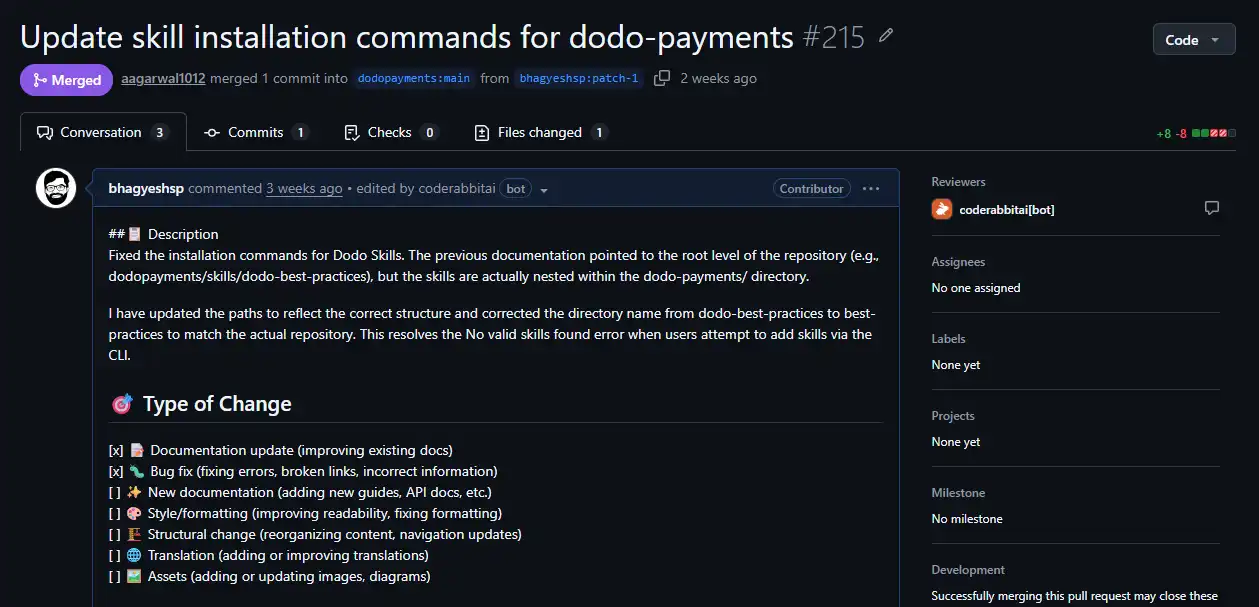
Let me show you what I mean. A few weeks back, I was integrating a payment gateway provider named Dodo Payments for my upcoming product Feedhammer. Some of their installation commands weren’t working as expected. I checked, understood the mistakes in their documentation. Since their documentation is opensource, I suggested the fix in their Github repository. Wthin 5 days, they accepted the change and updated their documentation. A company where I would not qualify for their tech hiring, I could contribute in my small way. All developers depending on their documentation would save countless minutes. Here’s the source:
Even if you’re not a programmer, you can contribute to opensource projects. Google or ask your favourite AI tool about contributing to opensource projects as per your skills and interest. It will guide you. Or look into this link and this link.
So, what’s the relevance of opensource with our discussion?
It has multiple dimensions:
We don’t need credentials to contribute.
We get the feedback of our contribution from the real world: if what you proposed was incorrect or was not matching the expected standard, people will tell you so.
We can’t fake our contributions. They have history and receipts.
In one sentence, you can just do things.
Take a lever long enough
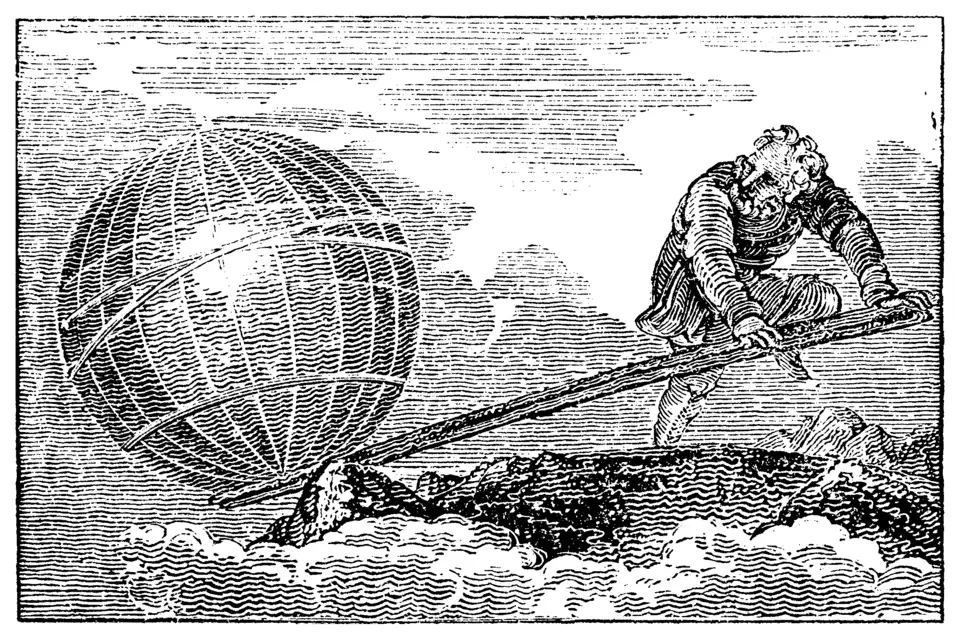
“Give me a lever long enough and a fulcrum on which to place it, and I shall move the world.”
Sometimes I think, if 2000 years back, people had found a lever and fulcrum for him, Archimedes would have moved the Earth. I have no doubt about it. He was just the kind of a guy who just used to do things.
We are not Archimedes and we don’t need to wait for someone to hand us a lever. We have AI, internet, computer and above all, more information than we can process in our life time.
Naval Ravikant has beautifully explained Leverage in this interview. That webpage has mentioned “leverage” 132 times. Because there’s a reason: leverage is everything for a man who just wants to do things.
Though Naval’s discussion and philosophy stems from his background in Economics and startup ecosystem, your leverage doesn’t have to be code, capital or media as he mentions. It can be just your connection and the care with which you take care of your customers.
You can’t build your leverage without going a bit off-track. Without tinkering with ideas and different types of work. The sure-shot way of finding and building your leverage is simple: just do things. The more things you do, the closer you get to identifying areas and building your leverage.
Once you have built a long enough leverage, find a fulcrum to place it on and move the earth.
You can just do things to build leverage.
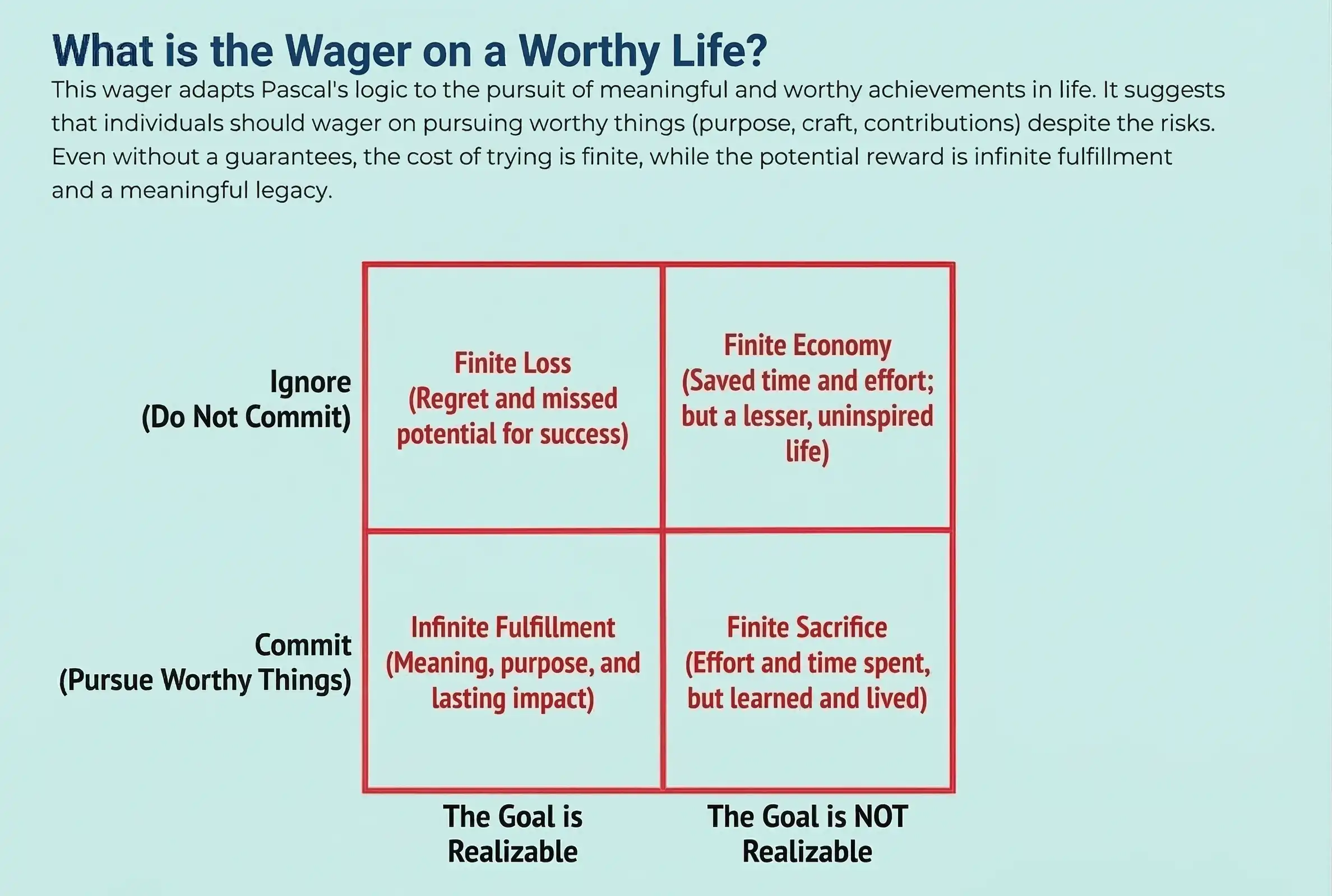
Pascal’s wager
I think about life in terms of a series of decisions. Choices if you like. And some philosophical tools make it easy to make decisions. One such tool is Pascal’s wager.
Approximately 400 years ago, Blaise Pascal shared his thinking about belief in god in a series of statements, ultimately concluding it was a better bet to believe in god than not believing. And now we can use his thinking as a philosophical tool.
I got the following image made using Google’s Gemini. The point is simple, there is so much to gain by committing to things and so little to lose if those things don’t work out.
All these 2000 words to tell you:
You can just do things.
You can just give your gifts.
]]>Bhagyesh PathakWu Wei cards are live!2026-03-27T00:00:00+00:002026-03-27T00:00:00+00:00https://bhagyeshpathak.com/uncategorized/2026/03/27/wu-wei-cards-are-live-Finally, wuwei.cards is live.
I first came across processing cards a few years ago. And their effect hasn’t left me since then, so much so that I’m going over so much trouble to provide the same experience to others. Crazy.
Wu Wei is an ancient Chinese philosophy, which loosely translates to “non-action” or “effortless action”. I came across the idea of Wu Wei while reading and re-reading the beautiful experiential book by Steven Simpson, called “The Leader Who is Hardly Known”. (I literally distributed several tens copies of that book in my circle at the time.)
One of the things that most facilitators miss out on is using props. Effective props. I believe Wu Wei cards are some of the most effective props a facilitator can use (of course, props are secondary, facilitation is primary).
This project has been going on at the back of my mind, through Hardi’s pencil and Bansari’s brainstorming for the last 4 years. And now finally, it has reached you.
The initial idea was to offer only cards but what’s the point of only having physical cards when the world works now through hybrid mode: physical + digital. Hence, the digital tools that supercharge anyone’s facilitation.
This is probably the world’s first digital facilitation toolkit with such a rich variety of interactivity.
The main point is: if you can’t afford or need the Wu Wei cards, it’s okay. But these powerful tools are FREE. Anyone can use them without spending a penny or sharing a login credential.
It is a gift–passed as received.
Since this product was manifested by the talented Hardi Shukla, you will see her fingerprints all over them: cards, companion guide, and packaging.
Shoutout to Vishwas Parchure for his DEEP facilitation. If it wasn’t for DEEP, I would have been building some fun applications but would have missed out on passing on these gifts.
wuwei.cards is the first major physical + digital + AI product by Sisyphus Consulting Pvt. Ltd..
And oh yes, soon, the Wu Wei Cards will be available to purchase online and in some select stores.
PS: To every friend whom I have been mentioning Wu Wei Cards product for last four years, this is it. Finally, it is published. :D
PPS: Pls visit wuwei.cards and let me know how you liked it.
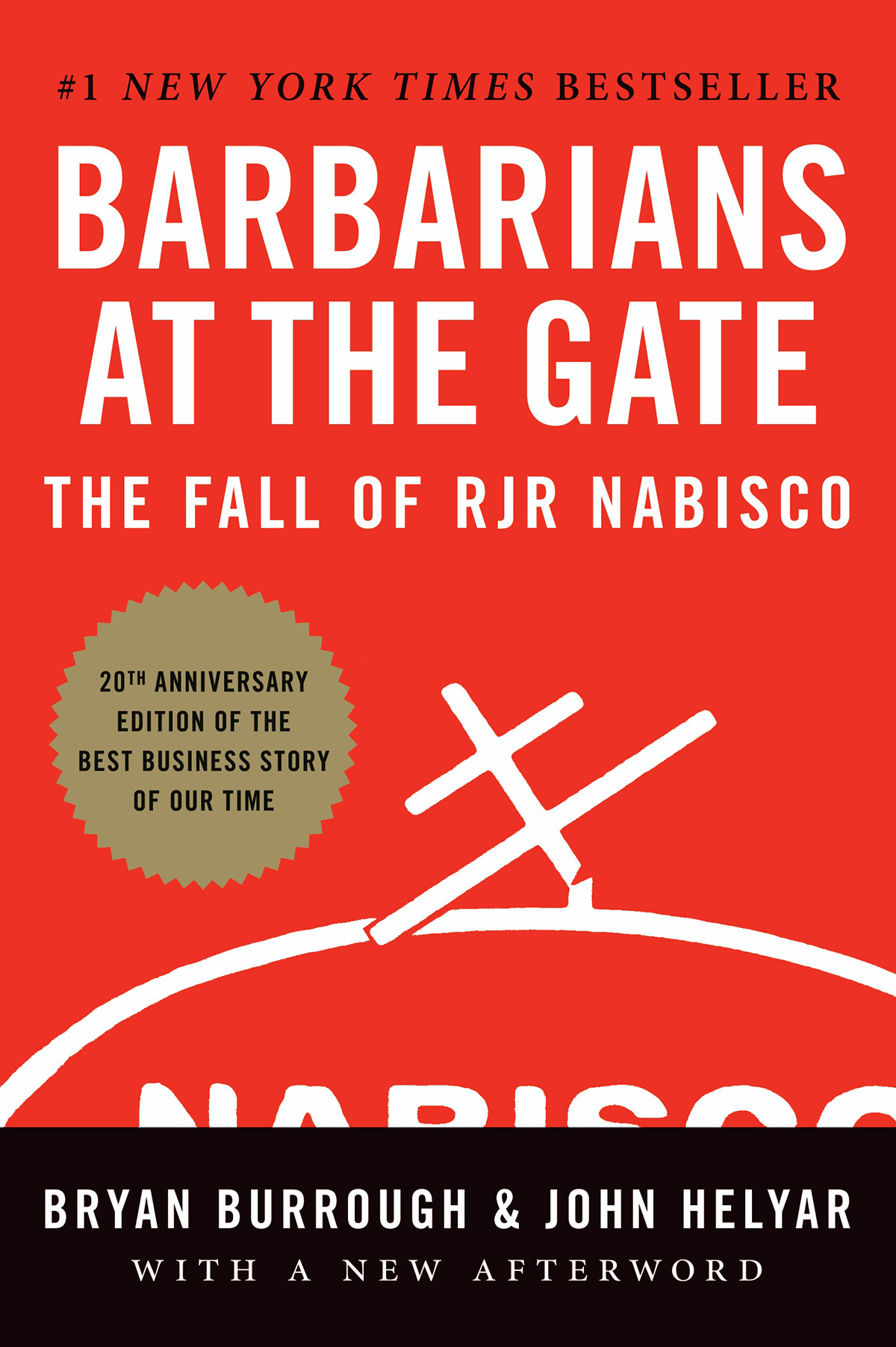
]]>Bhagyesh PathakBarbarians at the gate2026-03-13T00:00:00+00:002026-03-13T00:00:00+00:00https://bhagyeshpathak.com/uncategorized/2026/03/13/barbarians-at-the-gate-book-review
For some strange reasons, I came across this marvellous piece just a few months back. Once I had my hands on it, I just couldn’t stop reading it. One of the best piece of writing on financial transactions, board meetings, mis-management, ambition, greed..and above all, The Wall Street. I didn’t know that Wall Street had sooo much money. Soo much. And unimaginable might and will-power.
I do not have financial background but a strong interest in public companies that I invest into, their balance sheets and the common-joe stock market knowledge. But this real-life story. The whole thriller based on highly sophisticated financial instruments, strategies and the political economy has made me extremely interested in financial instruments that I didn’t care existed.
Of course, there’s a huge catch. I’m in India and this book is based out of the 1980s’ United States. India is a different and rigged game altogether. What makes me appreciate is the United State’s real capitalism at work. The sheer volume of talent, freedom and lack of red tape. I’m sure they must be having their own version of problems, but compared to India, it is a capitalist’s heaven.
This book also opened my eyes about why the US is called the land of opportunities. It feels illegal that there is a country where people can start at the bottom of the pyramid and reach the top of it just based on hard work, networking, risk and a little bit of luck. The chances of that happening in India are miniscule, it is exception not the rule.
Reading this book reminded me of three other Wall Street movies that I can recall: The Big Short, Pursuit of Happiness and Wolf of Wallstreet. The reason why this story felt so intense and impressive was its medium: book. If I had watched its film adaptation, I would have been impressed but not equally. It is like the difference between reading Harry Potter and watching Harry Potter. For the record, I have only watched Harry Potter, never read it. The act of reading communicates ideas through words and forces us to portray details on the infinite canvas of imagination. It is far more effective.
One of the qualities that I liked about reading the vivid details of the whole saga was the raw display of effort and hardwork against all odds. The soul-crushing rigorous 18-hour days, sleepless nights. The uncertainty, the maddening volume of paper work. Everything is inspirational. Of course, I don’t intend to covet such work but the hardwork is admirable. Those are the types of stories more people need to hear.
The story also shows how people’s personal ambitions and beliefs drive the whole world. I was quite moved by the description of how RJR Tobacco Company was founded by R. J. Reynolds. The way the authors have described Mr. Reynolds’ rise and contribution to Winston-Salem, I can’t help but resolve to visit this little town someday in my life.
I’m now wondering, any of my connections working for PE firms, VCs or Investment Banking really read such books? If I were in investment banking, this one would be one my go-to classics.
]]>Bhagyesh PathakThe pleasure of experimenting2026-01-12T00:00:00+00:002026-01-12T00:00:00+00:00https://bhagyeshpathak.com/uncategorized/2026/01/12/the-pleasure-of-experimentingI looove experiments. My childhood was full of hardware experiments and then I switched to software.
For FEEDHAMMER–the product I’m going to release for Sisyphus Consulting Pvt. Ltd., one of the key questions was this:
What is Google Calendar’s frequency of checking for new changes?
Now, as usual, I “researched” on the internet but there was no authoritative answer to this. And that makes sense because there are some obvious technical reasons.
So, what should I do?
Work on the product accepting the ballpark answers?
I would have but I like setting up experiments.
So, the solution was simple:
Write some code and record how often Google Calendar pings Feedhammer.
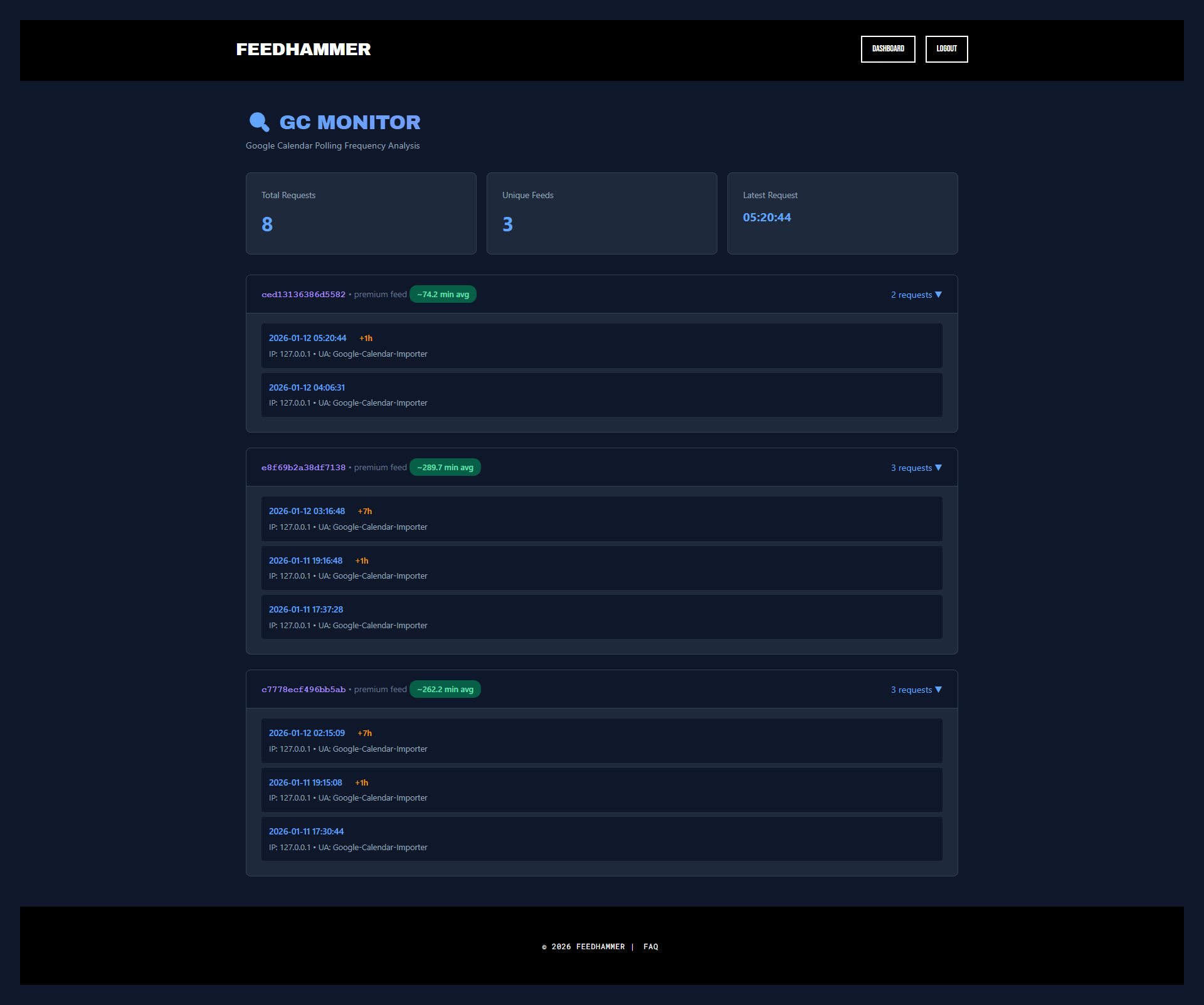
The dashboard you see in the screenshot is a quick-build for internal testing. I can’t describe how helpful agentic coding becomes in such a scenario. But that’s not what this post is about.
The pleasure of interacting with the real world, setting up experiments, learning from them…that’s beyond words.
For curious souls:
What’s going on in the dashboard:
Google Calendar is checking 3 test feeds I have created on Feedhammer. And we can see that after the first check, GC has checked again roughly after 1 hour and 7 hours.
The experiment is still on, let’s see how it goes.
]]>Bhagyesh PathakFollowing through2025-12-30T00:00:00+00:002025-12-30T00:00:00+00:00https://bhagyeshpathak.com/uncategorized/2025/12/30/following-throughAs we wrap up the outgoing year, we tend to promise to better ourselves next year.
And there are a ton of things we can promise ourselves about: exercise, meditation, nutrition, social life..etc. And when it comes to work, there are many must-have skills touted by different people. Sometimes, the list contains resourcefulness, adaptability, resilience, openness..blah blah blah.
All of that means little when people can’t follow through.
“I’m a very resilient man, but hey sorry, I missed meeting the deadline I had committed to you.”
Did you follow through on the work that you had suggested you’d finish?
Did you show up for the meeting that you had confirmed a week back?
Did you call for a follow-up after you had said you’d call for a follow-up?
These seemingly insignificant actions are not-so-insignificant when you notice that there’s something common among most of the people who get work done. All of them follow through. No exceptions. No excuses.
And on the other hand, the people who don’t get work done, they share the opposite of the same quality: not following through. Not doing what they said they’d do.
This is no surprise. Almost all cultures around the world figured out this important quality over millennia. They distilled this virtue in as “keeping your word.”
Marriage? Keep your word about in sickness and death.
Allegiance to your tribe? Keep your word on protecting their interest.
Parenting your kids? Keep your word about protecting and nurturing them.
Selling a bread? Keep your word about quality of ingredients.
You won’t find a culture that celebrates not keeping a word as a virtue.
And there’s a reason.
If you think about it, not keeping a word is equal to lying with your action. Generally, we limit the meaning of a lie to only verbal sphere. But in reality, the meaning of a lie is anything that deviates from reality. So, by not keeping one’s word, people deviate themselves and others from the reality they had promised. And no culture is going to embrace a liar. Not because of some high ethical grounds. But because of the threat it creates for survival. Lying doesn’t help survival. At least, that is what used to be the case before the dawn of the civilization.
In any case, why is it so tough to keep one’s word? To follow through?
I don’t know exactly and it is tough to make a case for everyone in all settings. But still, if we narrow down to the circle of the modern workplace, we can make some statements that may apply to the majority of people.
I look at it in this manner: why would someone intentionally not follow through? Why would they say one thing and do a completely opposite thing? One of the things that explains things is their inability to manage their time and model effects of their actions in their work and world. In one word, it shows the lack of “sound judgement”.
Unfortunately, in modern world, there is rarely any existential penalty for not exhibiting sound judgement. The world of work silently suffers from such individuals’ lack of follow through and there really, is no consequences for anyone.
Though there is no real punishment for those who break their word, there is some good news.
The world recognizes the ones who follow through. The ones who keep their word. And the rewards are beyond recognition. They’re translated into reputation.
Though I began this piece by mentioning “must-have skills”, I have to say that following through is not a skill. It is a quality. It cannot be learned, it has to be cultivated.
Drip by drip.
Probably it is one of the toughest things to develop, but following through on follow through is a hell of a thing you can do for yourself next year.
Or probably today?
]]>Bhagyesh PathakWhy people hide AI usage at work?2025-07-14T00:00:00+00:002025-07-14T00:00:00+00:00https://bhagyeshpathak.com/uncategorized/2025/07/14/why-people-hide-AI-usage-at-work Essay Outline
In 2022, when I came across DALL-E and ChatGPT for the first time, I was hooked. I spent hours and hours of my time tinkering with them. Apart from the fun, I wanted to find out their capabilities and limitations. What a feeling! Consequently, I couldn’t stop myself from sharing about it with the people I cared for. I had to share it with everyone I knew. I just couldn’t resist.
Why couldn’t I resist myself from sharing about these tools?
The answer lies in human psychology.
It is one of the most widely studied behaviour in the field of marketing. And while there are no right or wrong answers, I have a favourite answer: people purchase things or spread the word because it elevates their status in comparison to others.
Immediately our mind begins to verify this answer.
“Sent from my iPhone” signature in emails
“My BlackBerry Pin is xxxxx” (if you remember this, you’d also remember the glorious decline of that techno-social phenomenon)
And the latest one was the Studio Ghibli phenomenon
If it doesn’t elevate their status, people neither purchase things nor spread the word.
So, after the rise of industry-changing AI tools in past 2 years, we would have imagined a scenario:
Workplaces teeming with conversations about AI tools
Teams celebrating every new win they make in outsourcing grunt work to AI tools
People chatting about how they applied which tool to speed up their earlier process
Organizations incorporating AI-gains in their value chain
Hiring managers creating new frameworks for new hires to ensure they’re AI-ready
etc…etc..
But that is not what happened.
Sure, different surveys indicate that the usage of AI tools has increased multi-fold among employees. Take the latest one by KPMG, sampling 48,000 people from 47 countries.
58% employees use AI in their regular work. In emerging economies such as India, 72% employees are using AI compared to 49% employees in advanced economies.
The numbers are solid.
The adoption is fast and at an unprecedented scale.
But.
But.
But, the interesting thing is that not all who acknowledge AI usage at work in a survey actually acknowledge AI-usage in their work in their workplace. Saying “yes” in surveys, saying “no” when asked by a co-worker.
And that’s half-fascinating, half-confusing.
Why would people pass the opportunity of elevating their status by showing off their experiments and productivity with AI tools?
In other terms, why do they hide their AI usage at work?
The reasons
We can only guess what each individual’s reasoning might be. But when taken as a group, we humans are not that mysterious. It is little bit easier to assume a range of reasons for a group employees than an employee named Paresh.
Let’s try to touch as many dimensions as possible.
The AI-stigma
Many managers frown at the mention of AI usage in their work. It may not be as direct as frowning at a team member when they bring up the news of the latest AI tools, but it might be something quite indirect:
A subtle condescending tone while talking about AI
It might be their doomsday postings of “copyright violations, energy consumption…AI iS BaD..bEcAuSe cLiMaTe cHaNgE..”
It might be their attitude on AI’s reliability. There is a small echo chamber on internet that is hell-bent on finding faults with AI’s output which occasionally feeds their bias.
These attitudes seep up through the organization and what once used to be a team-limited “uncomfortable silence” turns into “stigma”, a “taboo”.
Most people do not want to engage with people harbouring irrational and unreasonable attitudes. This AI-stigma is no different. Team members read the room and they lay low. They do not share their findings and use cases about AI in their work. They become secret cyborgs.
Organic vs Inorganic
There’s a Korean channel on YouTube that publishes detailed process of how different products are made. They’re mostly from South Korean artisans and factories.
For example, I loved this one where the craftsman create beautiful Hiking Shoes by hand.
I’m sure people might pay above the market price for these shoes. After the industrial revolution, the supply of factory-made, high-quality products replaced the hand-made, moderate-quality products throughout the world.
Still there is a special kind of reverence, a spiritual ego boost in doing things with hands. Perhaps, Mahatma Gandhi appealed to this quality in people when he called on to them to boycott factory-made, English clothes.
This reverence for organic elements also permeate the modern work. For the workforce that has been in the market for last 3-4 decades, using AI tools may seem inorganic…inhuman. Feeding the cycle of shame.
Role of shame
“Shame is the fear of disconnection—it’s the fear that something we’ve done or failed to do, an ideal that we’ve not lived up to, or a goal that we’ve not accomplished makes us unworthy of connection. […] Shame derives its power from being unspeakable. That’s why it loves perfectionists—it’s so easy to keep us quiet. If we cultivate enough awareness about shame to name it and speak to it, we’ve basically cut it off at the knees. Shame hates having words wrapped around it. If we speak shame, it begins to wither. Just the way exposure to light was deadly for the gremlins, language and story bring light to shame and destroy it.”
– Daring Greatly, Brene Brown
Shame researcher Brene Brown has provided some of the foundational ideas on why we feel shame and how to get over it.
When it comes to knowledge work, is it any wonder that so many people might be feeling to have failed to live up to the ideal of “hand-craft”? It stands to reason that a Creative Head would appreciate their junior’s “hand-crafted” headline copies more than the ones provided by an AI tool in 30 seconds. Even if the AI ones were far better.
Imagine the condition of someone who works in an environment where accepting AI usage in their work is a matter of shame.
And that’s how shame sets its roots. Shame gets stronger with each unspoken word. Each hidden usage.
The efficiency trap
In most organizations and society in general, people who get work done faster than others, are underappreciated and suspected of compromising quality than their slower counterparts. Even if the faster people’s quality of work was better than the slower ones. It is probably one of those psychological illusions that we humans have developed over the years of evolution: “if it is fast and cheap, it is too good to be true.”
Most AI-users are aware of this efficiency trap. They know that completing and delivering work more efficiently than their peers may draw attention and unnecessary doubts about their quality of work. The solution to this trap is age old: deliver the work in average time. Sometimes with variation in quality1.
AI and doping in sports
In competitive sports, doping is use of athletic performance-enhancing drugs by athletes. It is a way of cheating.
Failing a dop test is a matter of embarrassment and humiliation. It is a career-ending event for athletes.
Due to whichever combination of reasons, if employees feel that AI usage is frowned upon in their organizations, AI becomes the performance-enhancing drug. A drug that lets people produce better work but they can’t admit their usage. And let’s be honest, the sweetest fruits are the ones that are forbidden.
In the wise words of Acharya Rajneesh: “निषेध से आकर्षण बढ़ता है।”
In context of our discussion: निषेध से उपयोग बढ़ता है।
Fear of job loss
Another reason is simple and understandable. If employees begin disclosing their AI usage in work and if AI seems to be surpassing their competency (which it will), the employer and colleagues would judge them as replaceable cog in the wheel. Combine this with the AI doom-and-gloom narratives. And you have created an existential threat.
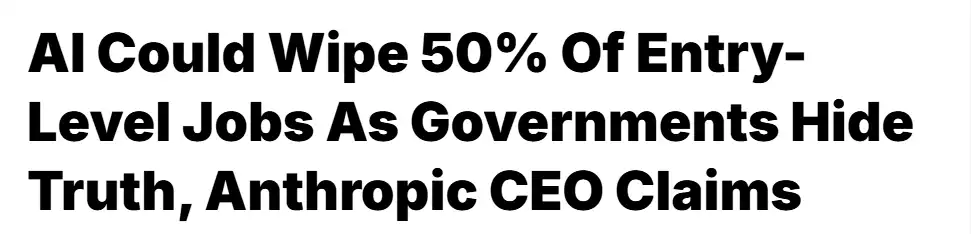
Take a look at some headlines from this year.
Almost every headline is programming the workforce to be fearful of AI. To treat it as an enemy. When so many screens scream at you with the same message, it is difficult not to internalize it.
And that’s one of the irony of employees hiding their AI usage: they’re seeing its benefit first-hand but they’re unable to reconcile it with the messaging of the doomsday scenarios, ultimately giving in the fear.
To exaggerate their contribution value
Perhaps, this might be one of the main reasons behind people’s under-reporting of AI. If they can produce a better work with less effort and time, they stand to gain multiple things:
Social status and career push by the perceived high contribution from them
Put considerably less effort and time. This increases the money-to-actual effort ratio. They don’t get additional cash per se. But we are going in with the assumption that “most people want to disconnect the effort and outcome equation”.
That’s what we call leverage.
AI acts as a lever
“Give me a lever long enough and a fulcrum on which to place it, and I shall move the world.”
– Archimedes
In post-industrial economy, no technology other than internet has held as much leverage as the current AI technology does. Almost all knowledge workers (and many manual workers) have access to the AI lever. Interestingly, most people do not want to show off this lever. Because showing off the lever may rob them of their leverage.2
This non-disclosure or under-reporting of the actual AI-usage provides an edge in workplace competition. If someone doesn’t know what or how much of a tool you’re using, they can’t prepare an effective defence against you. (As noted in the footnote above, I don’t think that’s a good and lasting career strategy.)
“Shadow AI” usage
Shadow AI is the usage of AI tools that happen outside security oversight, increasing risks related to data exposure and violation of secure cyber practices.
As found in this survey, “57% of enterprise employees input confidential data into AI tools”.
That’s the percentage of people who knew they were dealing with confidential data AND chose to answer accordingly in the survey. The real number would be way higher than that. And what do we mean by confidential data exactly? Here’s the breakdown from the survey:
31% reported entering personal details, such as names, addresses, emails, and phone numbers.
29% disclosed project-specific information, including unreleased product details and prototypes.
21% acknowledged inputting customer-related data, including contact details, order histories, chat logs, and recorded communications.
11% admitted to entering financial information, such as revenue figures, profit margins, budgets, and forecasts.
Any wonder people would hide their AI usage? Especially when they know they might be exposing sensitive data to AI models.
Before and After comparison
By sharing the extent to which someone is using AI in their work, they expose themselves to the scrutiny of their work without AI. And most likely, their work would seem subpar when compared to the AI’s output.
Disclosing usage of AI in their work draws a solid line in their career: “Work BEFORE AI” and “Work AFTER AI”.
For most normal folks like me and you, smart usage of AI in our workflow would make our ”BEFORE AI work” look dim in comparison to our “AFTER AI work”.
It is only humane to not want to put ourselves in such a situation.
Response to “what do you bring to the table?”
In the face of existential uncertainty in their career, whether a person is gainfully employed or looking for a job, almost every interaction seems to be asking them: “what do you bring to the table?”
Hiding the AI-usage might seem like their answer to that unasked question. It gives them a justification to get retained or hired, although that would not last very long.
Implications on other employees
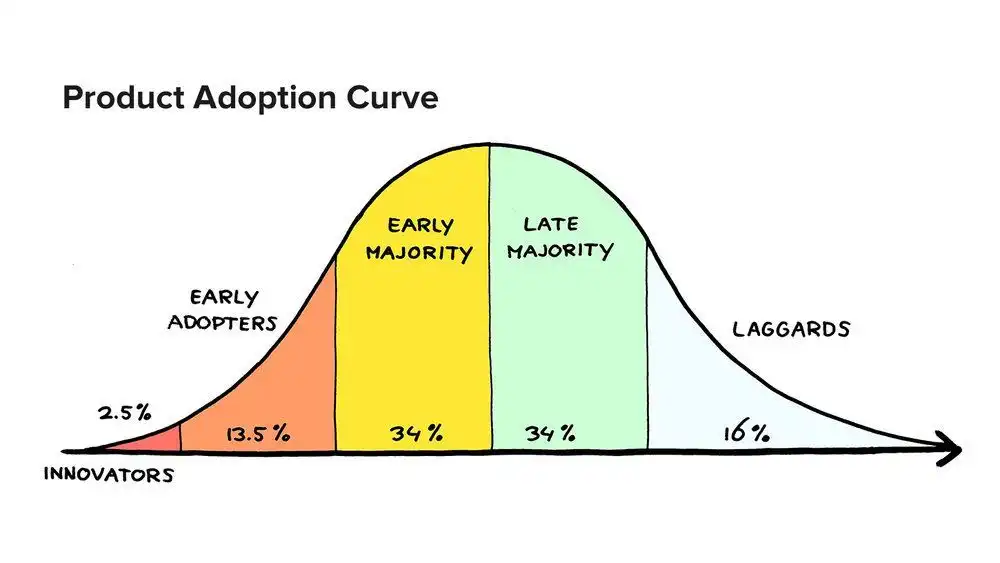
As it is with any innovation, the early adopters are always in the minority.
So far in our discussion, we have talked about this minority: the employees who have been using AI in their work. They’re powerful and their impact is not localized. But it affects the majority: the employees that are ignorant to the relevance of AI to their work. These employees fall under the other category of people who are not early-adopters (the 85% of any group).
We need to briefly discuss how the minority’s secret usage of AI affects the majority, and consequently the organization.
Late to the party
“What we have learned so far is that using AI well is a skill that needs to be carefully learned by… using it a lot.”
– The AI Memo, Tobias Lutke, CEO, Shopify
Most people using AI to augment their day-to-day work fall under the “early adopters” category. And most of them hide their adoption. As long as they keep it a secret, the rate of adoption to “early majority”, “late majority” and “laggards” will be extremely slow. Because it is the early adopters and early majority that spreads adoption of new ideas.
And ideas that don’t spread, die.
The act of not sharing AI usage in work, leads to a series of problems for everyone on the other side of the adoption curve.
The later the rest of the crowd sees the effects of AI in their work, the later they will tinker with it. And the later they tinker with it, the more difficult it would become for them to catch up due to these factors:
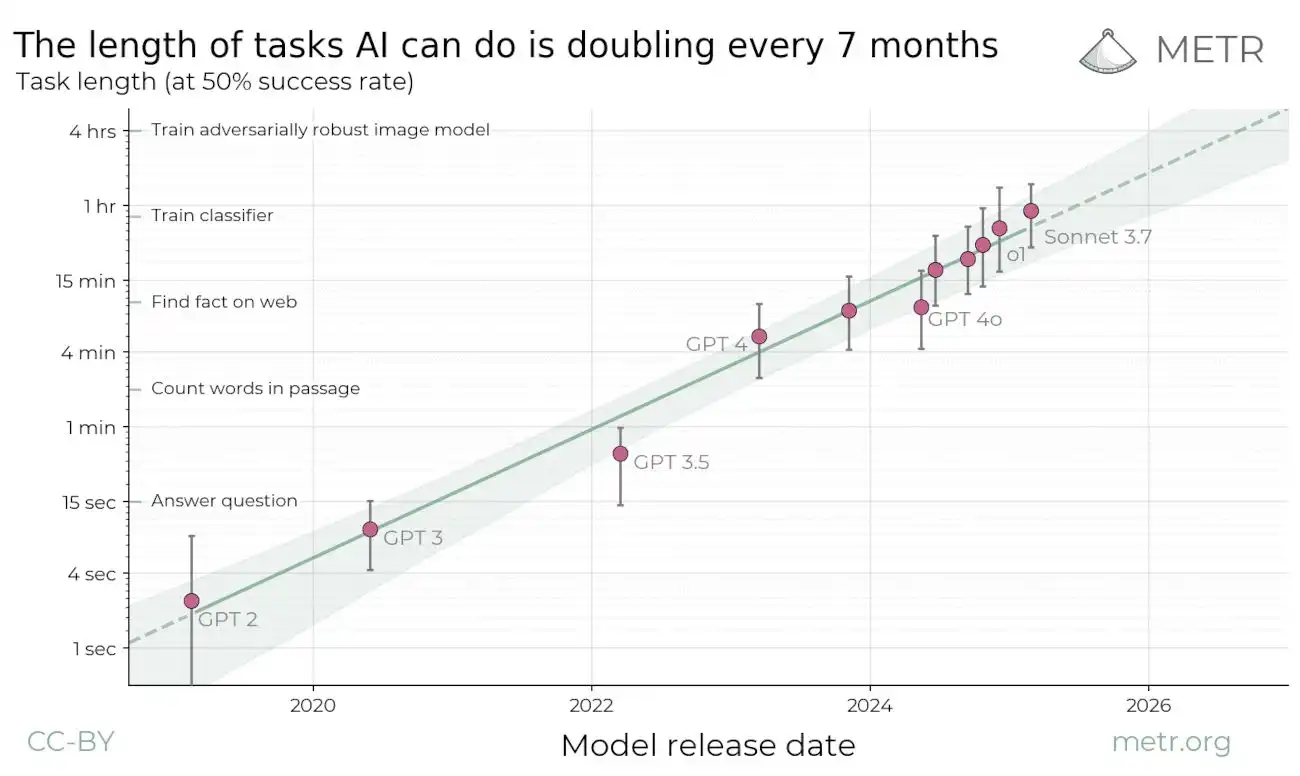
Steep learning curve: As reported by METR (Model Evaluation and Threat Research), the AI’s ability to complete tasks at 50% success rate has been doubling every 7 months for last 6 years!3 If this trend continues–which seems likely–the late adopters will have to face a steep learning curve because of the increased complexity of AI systems.
Futility: Having missed the early train, the late adopters may feel that catching up with their AI-ready competitors is simply futile.
Skill-gap: Trying to tinker with a more evolved AI would make the uniniated feel that the gap between his/her skill and the AI’s skill is staggering. This would in turn engender the “futility” feelings.
Not getting the reps: What Tobi pointed out in his memo to his people is spot-on. AI is not a genie and learning to use it requires tinkering. A lot of tinkering. The more time and practice one gets, the better. But someone who tries to adopt AI late would not hit the reps that an early adopter would have hit. In other words, they wouldn’t be able to punch in their 10,000 hours.
Parity with the stars
Every organization has a small star performer group and a big non-star performer group. If both groups begin tinkering with AI simultaneously, the initial phase may prove motivating to the non-stars because after all, they’d be able to create and solve ideas that previously were mostly monopoly of the star group.
This parity brings a sense of accomplishment. Euphoria. A quick win. It a powerful motivating factor to keep tinkering with the AI and keep improving. But hiding the degree of AI usage robs the non-star group of people to taste this parity with the stars. And eventually, costs the organization value creation.
Of course, this parity is unlikely to sustain because the tool’s usage is user-dependent. Eventually, star performers would remain top performers due to their domain knowledge, experience, and creativity. But the non-star performers would be nothing less of a 10x of their previous selves. And that is what counts.
Hopelessness
When organizations and their people create an echo chamber that banishes AI tools, majority of their people catch the late train (how late? that’s one of the deciding factors) to the world of possibilities.
The implication of being on the last lag of AI adoption may instigate the feelings of hopelessness (it is different than feelings of futility). These feelings get further reinforced when some of the risk-takers and well-connected fellows reach different heights in the organization using AI tools.4
Missing out on AI use cases
AI tools are “solutions” for which we have to find matching “problems”.
There’s no SOP, no playbook. People have to use AI in their day-to-day work and find out what works and what doesn’t work. It helps them develop intuition about what AI can do and find their eureka moment for their workflow.
This is an important experience that the other employees miss out on.
Consequently, this may perpetuate the false belief that AI tools are useful in some select domains only. “Not in my work…my work is too complicated to be done by AI”.
Feeling lost
In the middle of already strong narratives about doom-and-gloom scenarios, not knowing how the other employees are “making it” to the next rung, it is natural to feel lost. If no meaningful intervention is provided, it leads to the individual’s career stagnation and loss of interest.
Organizations might see a wave of such lost faces in the coming years.
Difficulties for organizations
Every organization is unique and complicated. Hence, it is difficult to estimate the cost of the hidden usage of AI for any organization.
So what can we do? Instead of looking for exact dollar or hour values in cost, we can list the difficulties such organizations would face. And let each organization assess what it would cost them to overcome those difficulties.
If an organization chooses to completely ignore the increasingly AI-dependent value creation in the world, their cost would be paid in the form of lost relevance.
Measuring and rewarding
Long before the rise of AI, organizations have been struggling to measure and reward performance “fairly”. It has never been a perfect system. Now, the additional layer of AI-enhanced performance is beyond capacity for most organizations.
For example, before introduction of AI, a junior programmer could complete 10 units of tasks per week. After its adoption, he is able to complete 50 units of tasks per week. That’s a four-fold increase in his performance.
How do we measure it? And subsequently, how do we reward it?
Determining baseline performance
Naturally, after a year or two of AI-enabled workforce, it would be extremely difficult to understand what baseline performance looks like for a given task. Here, “baseline performance” is the minimal expected work output of certain quality by an individual who is relatively new to that specific work.
Since the organization would be used to seeing AI-enhanced work for a long time, it would be difficult to judge the performance of the prospective hires (even if they’re AI-ready) for similar tasks. Their performance would seem dismal when compared to their counterparts already in the business groove and equipped with AI.
Without a reasonable standard of baseline performance, it would be difficult to judge someone’s work.
Naming a fair price
Similar to the problems of measuring and rewarding, compensating people fairly would be a tough task. There are two types of compensations issues that organizations would run into:
The AI-adopters: These members would have been with the organization before the AI revolution. They adopted AI, contributed to the organization’s growth. In many cases, initially self-taught and self-funded AI adoption, later funded by the organization to continue the work. Since the AI adoption would increase productivity by 10-50x, reflecting in profit too, how would the organization price the AI-adopter’s additional value creation?5
New AI-ready hires: Before AI, pricing a role was already a difficult task. Now this task has an additional layer of gauging: the organization needs to understand not only the candidate’s raw capacity but also AI-enabled capacity.
Estimating the conversion factor
I was struck by this idea while writing a footnote for one of the former paragraphs. Understanding the importance of this idea, I feel obliged to expand it as a separate heading.
Suppose an organization is operating a coal mine and recruiting miners through contractors. It’s a manual coal mine. Each contractors are paid in the proportion to the coal mined by their miners. If the contractor brings more miners, or experience miners, it would reflect in the increased output on a daily basis.
Here, we can draw a straightforward cause and effect relation between the number of miners and the quantity of coal mined. Under ideal condition, the conversion factor of the productivity gains is almost 1. Every addition of a miner leads to → increase in coal mined, which in turn leads to → more money for the coal company, which leads to → more money for the contractor.
Now, with AI, we are not dealing with coal mines or miners. But like the coal company, organizations live on profit. Their business value leads to profit.
The tough question for organizations is to estimate how much of the additional business value gains made by the AI is actually converting to profits. This conversion factor will always be in ranges. And estimating this range is important for making long-term investments in AI at organization level.
Estimating this conversion factor is one task, another task is to get a consensus on the conversion factor. Since it is not an exact science or arithmetic, organizations would need to invest heavily in making sure that the basis of these estimates are as indisputable as possible.
How do you measure engagement?
For most knowledge workers, showing up at 9 to 5 job in the office is a mark of successful engagement. If they’re remote, answering a phone when called, being present in virtual calls and not messing up deadlines might be a mark of successful engagement.
But now when the AI-augmented employees can do the same work at the 10x-50x speed, organizations may need to change the terms of calling an engagement successful.
And what would those terms be?
The number of successfully submitted assignments?
The quality of successfully submitted assignments? (If yes, who would decide that?)
A high ratio of quality/time-to-complete?
Impact of assignments to the direct profit? (If yes, how would they determine the conversion factor?)
The degree of innovation?
The difficulty level of problems getting solved?
Confidentiality dilemma
Encouraging people to adopt AI may sound as easy as asking them to sign up for personal ChatGPT account and begin tinkering with it for work. But as we discussed in one of the previous sections, a majority of workforce is feeding confidential and sensitive information to AI tools. It may seem like a no-harm-no-foul practice until a major security incidence takes place.
The challenge for organizations is to define, implement and monitor different security practices for their people. And even after implementing guardrails, organizations would need to identify certain business operations that should never be exposed to AI tools.
Risk mitigation
As we discussed, training people on best practices of safe AI-usage, maintaining boundaries and monitoring their compliance are difficult tasks. After implementing them, if there is still a breach of confidential data or any similar incidence, how would the organization respond?
Every organization would need to re-assess their vulnerability and prepare mitigation plans. The points of vulnerability would be drastically different and far more in the post-AI business processes than the pre-AI ones.
Getting the top teams on-board
In most of the mature organizations, the executive team comprises of executives with a wealth of experience. Getting them to try the AI tools is ironically difficult.
There are couple of reasons behind this:
Chasm between workers and decision-makers: After years of experience making high-level decisions and not being involved into the day-to-day, it might be difficult to draw a parallel on the applications of the AI in day-to-day operations for their workers.
Just another bubble: Senior executives have seen all rain-and-shine and bubbles in technology domain. Thinking that AI is just another bubble is an easy trap to fall into.6
Worker protection: Even if they are convinced of AI’s usability, with a misplaced sense of protecting their workers, the top teams may want to postpone AI-integrated work culture.
Upskilling or re-casting?
On an average, for most mature organizations, a significant portion of the workforce is older than the the rest. While old age doesn’t necessarily translate to learning-challenges but there would be instances where it becomes difficult to learn new tools and model their application in day-to-day work. This is going to be a widely spread problem in any organization.
Depending on their nature of job, experience and competency, a minority of these employees would need upskilling while the majority would need to be recast in a way that capitalizes on their strengths. They may never need to touch AI tools, but only direct the other team members.
Hence, organizations need to be prepared for a humungous organization-restructuring exercise.
AI interaction changes processes
Until now, we have been considering AI tools as just another set of tools that need to find their space in our workflow. We have assumed that the old pipeline would remain unchanged. But the reality of effective AI tool usage is two-way. We modify AI tools to fit our workflow and the AI modifies our workflow to maximize its benefits. This is an automatic process. The more we begin to integrate the AI tools in our workflow, the more we are challenged to question our processes.
Now, if you have seen organizations grow, you’d quickly recognize that this has been true for any enterprise software too. For example, if you subscribed to a CRM software for your organization, there is only so much you can customize. Ultimately, your staff needs to make changes to their processes to align with the software workflow.
But but..AI tools are different. They’re flexible. They can meet where you are.
The question is, where do you want to meet the AI tool?
And that’s the question that trips most organizations. There are no right or wrong answers here, but it helps to be creative and ambitious in this undertaking.
Hidden liabilities
As reported in the reasons earlier, “57% of enterprise employees input confidential data into AI tools.” We also discussed that the real number would be far greater than the 57%. And it was just one survey.
This trend means only one thing: organizations are unaware of the degree of their liabilities. It cannot be measured right now and so can’t be mitigated.
Organizations, whose business survives on their proprietary practices and deals with sensitive information at scale, they would need to revisit their security practices.
Unpredictable overhead
If organizations recognize the need for AI tools and begin supporting their people with organization-wide access to premium AI tools such as ChatGPT Plus, what would be their overhead? That’s a little bit predictable since it is a subscription-based model.
But things get complicated fast when organizations decide to use AI APIs in their workflow. Since API services follow usage-based pricing, the cost projection is complicated. This part is difficult but not exactly unsurmountable. Organizations need to set right expectations about the financial and technical complexity of this part from the get go.
By now, you, the reader would have realized that the task at hand is tough. Handing over AI tools subscription to your people is not going to make it. But still, you have to start somewhere.
Organizations can begin by setting up some concrete goals. One of the goal can be as simple as: encouraging people to be honest about their AI usage and inspire others.
To achieve their goals, organizations can employ combinations of different strategies. Overall, the following actions can be undertaken to implement strategies.
Starting small, aiming big
In 2022, the business world was awash with AI-integration news. Start-ups, grown-ups, everyone was announcing their version of “we’re ditching whole teams for AI tools”. None of them were as loud as Swedish fintech giant Klarna’s decision to replace their customer support staff of 700 people. To be replaced with AI. By 2025, they had to resume hiring customer support staff since the AI tools were not as effective as actual humans.
None of us knows what exactly went wrong with Klarna’s AI tools, but we can be sure of one thing: they tried to start big in over-enthusiasm.
Learning from examples such as Klarna’s failures, organizations can start small. As we discussed before, AI tools are solutions we need to search problems for. We need to understand our context and processes first. Once understood, we can identify a small, automatable task in a workflow that can be used as a pilot. And build on it slowly.
Iteration is the key here. Integrating AI in organization processes is similar to developing a good software. In this case, the organizations experience what goes wrong during the development process, the same way a software developer sees the bugs first-hand.
When organizations begin such small scale pilots, it acts as a magnet for people who are using AI in their work. They feel related and willing to contribute.
Ask and you shall receive
Requesting team members to come forward with their experiments with AI is a low-hanging fruit. It is straightforward. And one of the most effective action managers can take. It doesn’t require any drama, strategy, 10-people-meeting or a memo. Simply asking and encouraging team members to begin sharing their AI-usage in work.
Agreed, it may not guarantee a full disclosure from people, but organizations have to begin somewhere.
Begin from the top
Leading by example is a powerful strategy when it comes to AI usage in the workplace.
As we discussed earlier, while it might be difficult to get some of the executive team members on-board, they can be pursued by experiencing small bits of AI usage in their work. It has to be meaningful though. It can be as simple as providing an AI-enabled summarizer bot that summarizes key insights from one of the dashboards they’re used to look at.
The more visionaries of the lot at the top can also begin treating the non-adoption of AI among their teams as existential threat–which it is true–and that may move a needle.
Dharmesh Shah, the CTO of Hubspot, has been vocal about his tinkering with AI tools for a long time. He has already built an interesting AI product: agent.ai
Whether it is Tobi or Dharmesh or anybody of their stature, by publicizing their usage, these people are not only leading by example, but also they’re getting a real-world feedback. Not to mention, the kind of top talent they might be attracting towards them.
Revamping incentive structure
“Before asking for more Headcount and resources, teams must demonstrate why they cannot get what they want done using AI.”
– The AI Memo, Tobias Lutke, CEO, Shopify
The last part of the Tobi’s memo is quite interesting. He has rightly drawn a line as any business owner should. If you notice, Tobi hasn’t indicated that people are going to lose their jobs. But he has clarified that people owe some justification before asking the organization to spend additional resources.
So, how do we incentivize people to be intellectually honest in justifying their need for additional headcount?
One way might be to share a percentage of expenses saved with the people. If 10 employees are doing the work of 15 people, they need to be incentivized by money, time, and status for the savings of 5 people worth of expenses. How much to be incentivized? We’re back to estimating the conversion factor.
And if people get greedy, not expanding their team for additional incentives, it would reflect in their deteriorated performance.
AI-tools ready hardware
Most companies tightly regulate their company-issued devices to keep them secure. But sometimes, it makes it difficult to experiment with AI tools, which may require new combination of security parameters. There are solutions available in the market that doesn’t compromise security and data while allowing tinkering with AI.
Organizations need to invest in understanding their requirements and getting the solutions that suit their needs.
Celebrating doping in sports
The history of sports is filled with controversies of doping athletes and their humilation. For an elite athlete, being found guilty of doping is a career-ending event. In such a culture of preserving human potential, integrity and hardwork, what if someone celebrates doping? What if they encourage doping in competition?
That’s what the Enhanced Games events are going to do. They’re scheduled to inaugurate in 2026 where the participating athletes would have trained on performance-enhancing drugs. As controversial as it may seem to be, the founder Aron D’Souza has taken a bold step and tapped a whole different market.
In the world of business, organizations need to rethink the way their people work. They need to have their own Enhanced Games version of teams. Celebrating AI-enabled performers and acknowledging their contribution.
Policy framework
Adopting an organization-wide AI policy and providing controlled infrastructure is one of the most effective ways organizations can protect themselves against unsafe AI usage that would lead to unlimited liabilities.
Ideally, the framework should be tailored for each organization’s specific needs, however, one can start by using templates such as this one published by PwC. [Attach the document]
De-stigmatizing AI usage
Stigmatic topics remain stigmatized for not seeing the light of day. One of the ways to de-stigmatize them is to talk about them. Sounds boring but organizations can get creative without spending much effort.
There are different ways to create a space for such type of discussions:
Organizing weekly/monthly discussion groups
Beginning a newsletter, highlighting organization-wide updates, including AI-usage stories
Publicizing case-studies about what worked and what didn’t in your organization
Going local
It is tempting for many organizations to rope in external parties to encourage and educate their people on AI usage.
There are at least two possibilities when people from outside are brought in:
One of the most common ones is the increase in internal resistance. If not handled well, outside hires, whether they are consultants or conference speakers, get pushback from the people. There might be several reasons behind such internal resistance: such as lack of shared business or cultural context, lack of time for developing rapport between outsiders and insiders, etc. This may do more harm than good.
Another not-so-common but not-so-impossible one is when there is total submission, almost a reverence for the outsiders. People may even feel grateful for the guidance and support they receive from the outside hires. This is equally problematic. Because it gives rise to three problems:
It sends a message to the employees that the organization has little-to-no innovation capacity or risk-taking attitude, and hence completely dependent on outsiders.
It may seed the idea that AI is too difficult to be handled without outside help.
It sends a strong signal of discouragement to the early adopters within the organization. Because if not consulted, they feel marginalized and devalued.
That’s why, taking help from internal talent is a good long-term solution. Identifying people who make AI-aided impact and inviting them to act as champions within their teams has a better ROI than any other options.
So, shouldn’t organizations hire outsiders in their AI-adoption, ever?
Not exactly.
The initial steps should be local. Once the internal champions are set and the dialogue has begun, adding external parties would only enrich everyone’s experience.
Adapting business goals
After a few months of using AI tools in different workflows, it is likely that the organization would have hit a new expectation milestone. For example, if one of the workflows includes writing SEO-friendly meta-descriptions for client websites, what used to take a week for 100 webpages, might be taking less than 2 hours.
This new expectation milestone of 2 hours should be included everywhere:
Project timeline projection
Performance management
Pricing
Without formalizing and acknowledging these gains, organizations may suffer from amnesia about AI tools’ contribution.
Hiring for AI-readiness
In addition to retaining and retraining people, organizations have to look for new hires that are AI-ready for a job role. The fresh blood provides a much-needed hope and peer-training within the organization.
As discussed earlier, hiring for AI-ready people requires organizations to be clear on what exact core skill they would like to see in the prospective hire. Understanding the nature of job and setting up a baseline expectation for the new hires would help the recruitment process.
For example, if looking for e-commerce store cataloguing expert, the baseline expectation should be clear that the cataloguing expert should be able to generate meta-tags and technical copies for each product using AI tools. Not only that, they should be able to understand whether the AI-generated copy matches their client’s positioning.
This example baseline provides much better idea to the recruiters and the prospective hires than simply asking them whether they know how to use ChatGPT.
As we discussed about AI’s impact on processes, smart organizations would quickly identify where they need to adjust their processes to match AI.
This may mean breaking from established processes or habits. Some adjustments would be necessary to reap the benefits from AI-integration.
One of the key adjustments is getting concerned people on-board. Software systems do not have any sense of preference, it is the people who do not appreciate change. Undertaking a large-scale exercise to cultivate trust and ownership in making this change happen would be necessary.
Managing Tech-Doom Crusaders
There’s a growing faction of small but loud-mouthed group of people who are on their next crusade to ban AI tools. Their reasons may vary but the underlying tone is always the same. Their message invokes a combination of these emotions: fear, guilt, hopelessness and self-loathing.
For example:
“AI is going to take over, it is going to replace us. People are already struggling to keep afloat in this economy. To top it, the amount of energy a single prompt uses is insane! It is only going to accelerate the cLiMaTe cHaNgE. We have a moral obligation to question it and save millions of people from the looming societal collapse.”
The content and tone of their sentiment may vary but the emotions they evoke remain the same.
Organizations need to identify such Tech-Doom Crusaders early on and “manage” them. If left unchecked, the organizations would pay the ultimate cost.
Demystification sessions
AI is mysterious. Calling it “AI” makes it even more mysterious and it feels alive. If we call them LLM (Large Language Model), it decreases their shine and also, LLM is an uncomfortable tongue-twister. (Try shouting LLM thrice.) Plus, using the term AI in your product increases its perceived value by several fold.
In such a situation, most companies developing AI or selling AI products have an incentive to keep things as much technical and mysterious as possible.
Organizations that struggle with AI adoption (i.e. almost all organizations) in their workplace have an opportunity to arrange knowledge sessions on demystification of AI. This is one of the few lowest hanging fruits organizations have. Demystification assuages fears and makes some room for reflection.
There is nothing noble in being superior to your fellow men. True nobility lies in being superior to your former self.
– Ernest Hemingway
Depending on your job role, goals, and temperament, your ways of doing things may differ from the way of other people’s doing things. Still, we can employ a simple heuristic to track if we are progressing forward: asking ourselves “are we inching towards the goal set by ourselves?” Speed doesn’t matter as much as progress.
Here’s a list of resources to help everyone get started on their AI-readiness journey:
Ethan is a proponent of using paid version of products such as ChatGPT. He is right in the sense that the premium models are mind-blowing in their abilities to solve complicated problems. BUT if committing $20 is too much for you at the moment, continue tinkering with free models. Just begin.
I have been using different AI tools since their debut and Jakob’s analysis is accurate. When AI-pessimists say that AI output is flawed and unreliable, I know they haven’t tried the tools.
This article is not exactly about AI adoption. But I can’t stop thinking about how organizations and people falling in the trap of “game denial” when it comes to AI.
In this fascinating experiment, Anthropic shared how their AI model Claude handled their office vending machine operation. This article will provide ideas about how AI is going to permeate in different aspects of our lives. But more than that, it will spark your imagination.
This article provides specific ideas for different management roles: sales, operations, human resource, finance, technology, risk management, and marketing.
FOOTNOTES:
I can’t stop myself from thinking about one of a senior employees I worked with 10 years back. The work included creating and checking educational curriculum. On daily basis, I have seen her redoing the same work twice just to seem busy and not over-deliver. Once she suggested that I do the same to increase the value of my work. I had to politely decline her suggestion. Mind well, this was before the age of AI. ↩
I’m not suggesting disclosing the exact AI levers in workplace. It is possible that people might have different way of navigating through their careers. They might have different goals than what organization might have. And that is completely fine. If using AI as a secret lever/weapon is a strategic choice, then I respect that individual’s choice. Having said that, I don’t think this strategy will take them to places. It is myopic at the best. ↩
Summary: We propose measuring AI performance in terms of the length of tasks AI agents can complete. We show that this metric has been consistently exponentially increasing over the past 6 years, with a doubling time of around 7 months. Extrapolating this trend predicts that, in under a decade, we will see AI agents that can independently complete a large fraction of software tasks that currently take humans days or weeks. ↩
It is not entirely guaranteed that catching an early AI train is the sole factor behind someone’s career success. Because most times, the reality is complicated. Sometimes, early adopters are the only authority figures companies can bet on for trying out practical usage of tools. So, what seems to be a well-designed career progression from outside, might be a combination of preparation and opportunity. ↩
This piece of argument assumes that the value creation aided by AI is indeed translated to profits. We will probably never be able to attribute how much of the additional value created using AI translated to profits. What would be the conversion factor? Factor of 0.3, 0.5, 0.8? Your guess is as good as mine. ↩
If we take AI developer companies at their every word, then of course, we are setting ourselves for disappointment. Since they have an incentive to exaggerate the capabilities of their products, it is obvious that they would overstate them. But we don’t need to look up to the future. What we have at the moment is already remarkable and anyone calling it a bubble does not have your best interest at heart. Having said that, what I wouldn’t prefer is: go all-in and splurge money in the stock market rooting for some AI companies. Because again, what’s the conversion factor for organizations adopting AI? If it is making money for the organizations that use these AI tools at a very high conversion factor, then I missed the opportunity. But that we will never know. ↩
]]>Bhagyesh Pathak🪜(Part-2/2) Increasing the surface area of luck2024-11-29T05:02:39+00:002024-11-29T05:02:39+00:00https://bhagyeshpathak.com/newsletter/2024/11/29/part-2-2-increasing-the-surface-area-of-luckI love science.
I’m sure you’d have noticed that.
So, whether you love science, you have to listen to this incredible thing.
Our digestive organ–small intestine is 3-5 meters long, with a diameter of a mere 2-3 cm. That’s like a normal PVC water pipe in our home.
That’s not incredible.
The incredible part is this:
The small intestine’s effective surface area could be as large as several tennis stadiums!
Look at this image:
As we zoom into the fine structures of the small intestine’s wall, we can see how even a small patch of wall is lined with thousands of folded structures–each increasing the surface area by hundreds of magnitudes.
So, our food passes through touchpoints that measure several tennis stadiums!
Who had thought that our tiny tummy space could encompass stadiums?
Everything starts making sense as soon as we start thinking in terms of surface area.
One of the core ideas in influencing our luck is seeing it in terms of surface area.
So, let’s begin with understanding luck first.
100s of factors = luck
So many factors make up luck when it comes to career advancement.
Let me list out a few:
Age
Sex
Languages
Genetics
IQ
Appearance
Health
Personality and temperament
Socio-economic background
Parental influence
Peers
Natural inclination
Years of work experience
Domain of work
Types of work/projects undertaken
Network
Publications
Exposure to complementary fields
Financial health
Of course, this is not an exhaustive list. It is impossible to account for all the factors that make up a person’s luck.
But you got the idea.
Also, let’s not mix the two types
If you think about the items in this list, you will quickly identify some factors that you CAN’T control:
Age
Sex
Native language
Genetics
IQ (It is very tough to get a reasonable increase, so let’s keep on this list)
and other relevant ones…
And then there are some that you CAN influence:
Languages
Appearance
Health
Peers
Domain of work
Types of work/projects undertaken
Network
Publications
Exposure to complementary fields
Financial health
and we can come up with other related ones…
You can see that we have been mistakenly mixing them with other factors for a very long time.
Now, we have clarity over what makes up for career advancement:
Upskilling + Factors in our control + Factors outside our control = career advancement
The surface area of luck
Similar to the small intestine, the factors under our control may seem insignificant. Right now, the factors are just words. A bullet list. A 2D depiction of the concept.
But we have to think of luck–the factors–in terms of surface area. And quickly, you will notice things changing.
Let’s compare Jolly Joe and Worried Will
Two men, Joe and Will, are the same in many aspects:
Both of them are men with similar age
Both of them have 8 years of work experience
Master’s Degree in a similar field
Have worked in the IT sector
Have a circle of supportive friends and family
But, can you figure out why their career is on different trajectories?
I know my drawing may convert you into Worried Will, but what can we do? I can’t upskill myself in the middle of writing, right?
Worried Will is worried for a reason.
He doesn’t get as many opportunities as Jolly Joe. Because Joe has tried different domains of work, different companies, different colleagues…and he is in touch with things outside his full-time job.
In other words, the surface area, the literal touch-points for Joe to get better career opportunities are far more than William.
And things do not stop at just “opportunities”, Joe has developed confidence by:
Taking risks of getting into domains other than his familiar ones
Keeping the learning pace steady by working on side projects
Building a protective financial shield by saving some money
Every single decision has increased Jolly Joe’s exposure to the chances of advancing his career.
Increasing the surface area
You’re smart enough to figure out what we need to do to increase the surface area of our luck.
If we had Rs. 1,00,000 and 1000 hours per year budget for career advancement, it would be wise to expend the money in a way that increases our surface area maximally.
Instead of putting all of the eggs in one basket called “upskilling”, we could have diversified a bit with some combination of:
Working on a side project
Learning new tools related to our fields
Reading about things that interest us
Watching movies, documentaries, and podcasts that interest us
Writing and publishing our thoughts for a larger audience
Taking up lead and responsibility at work
Speaking our mind at work
Assessing our financial condition before getting into debt
Taking up work outside our field of expertise
Spending time bonding with colleagues and friends that fulfil our lives
These things don’t provide certification. And that’s why they are more valuable.
Now, add upskilling to it
As discussed last week, the term “upskilling” is a catchphrase, a self-defeating spell for anyone who uses it. But still, let’s use it and discuss it a bit before winding down today’s letter.
Who do you think stands a chance to benefit more from “upskilling”: Joe or William?
I can’t think of any reason why William would benefit more than Joe. But Joe will benefit far more than William.
You can see, that “upskilling” doesn’t tip the scale that much.
A luckier tomorrow
Though we used a comparison between Jolly Joe and Worried William, in practice, I subscribe to the idea of comparing ourselves to our previous selves.
Our today should be more lucky than our yesterday.And our tomorrow should be more lucky than today.
A simple progression.
But compounding over time.
By the way, have you watched the famous F*** Around and Find Out graph? You can find the original one on YouTube, but I liked the one posted by this user. He’s right and it matches our discussion on increasing our surface area of luck:
Personally, I’m not interested in the idea of “advance..advance..” war cries of career. Because that’s propagated by a specific group of people, for a specific purpose. Tomorrow, our hearts may stop in a split second and on our deathbed, we won’t recall the all-nighters we had pulled through. Life is richer than that.
So, to each, their own.
What have been your experiences and observations related to career advancement?
Hit Reply and share your thoughts with me.
Also, forward this letter to anyone who may find it useful.
Reads of the week:
Link
I knew that there were Aztecs some 500-600 years ago in Mexico, but I didn’t know about the Death Whistles thing.
The death whistles were made of ceramics or clay. Archaeologists have been unearthing the skull-shaped whistles since 1999, buried with human sacrificial bodies.
There are many plastic copies available in the market and you can hear their sound on the internet. The sound is exactly like how a person would scream if they were being killed.
It gives goosebumps.
There are many theories about the purpose of death whistles. The most believable and chilling explanation I found was in ESR’s post:
“[…] The factual piece missing from the article is that sacrificial victims were drugged into semi-consciousness so they wouldn’t struggle and disrupt the ceremony.This meant they didn’t scream as obsidian knives were penetrating their chests and their hearts were ripped out to be offered to the gods. Obviously, the Aztecs considered the ceremonial experience incomplete without the screaming, and built death whistles to simulate the proper sound of agony.[…]”
]]>Bhagyesh PathakTFN#80: 🪜(Part-1/2) Why focusing on upskilling may be dangerous to your career?2024-11-22T05:01:20+00:002024-11-22T05:01:20+00:00https://bhagyeshpathak.com/newsletter/2024/11/22/part-1-2-why-focusing-on-upskilling-may-be-dangerous-to-your-careerReader, don’t get me wrong.
I’m a believer and practitioner of life-long learning.
In this two-part letter, I’m talking about “upskilling”—it is far from “learning”. It’s a deceptive term. So, I hope I don’t confuse you by mixing the two.
Now that’s out of our way, we can focus on the main subject.
If you’re in India and watch YouTube videos, you might have encountered some ads about upskilling. Almost all of them have a poster that looks like this:
A beautiful model wearing a worksuite
Using a power pose
Looking directly at the camera
Some hashtag that sounds powerful
There are hundreds of other companies making similar ads. And to fuel the fire, government agencies keep coming up with similar programs. Look at this news bite from 2021:
And if you work in an organization, you are likely aware of the effort they have been making to upskill their employees.
Like a war-cry, everyone shouts “upskill..upskill..upskill or vanish!”
It feels like the whole world is going through great turbulence and everything is uncertain.
But..
But…
But we need to pause for a minute. And reflect.
When did we adopt this catchphrase: upskill?
Google Search Trends provides some clues. As you can see in this search trend analysis, the first peak in interest for “upskill” appeared in April 2020. And now the interest has almost quadrupled in 10 years!
Yes, that time when so-called EdTech and online certification companies had the full attention of work-from-home employees, with nothing much tangible to do.
I remember social media feeds full of people sharing some or other online certifications every other week. A social race to show a piece of electronic paper and then rush to another one.
My guess is, that’s how we ended up adopting this catchphrase: upskill.
Why “upskill” is a trap word?
When we use the term upskill, we automatically make some dangerous assumptions:
Assumption no. 1:There is always a next upgrade possible for a given skill.
Assumption no. 2:The current level of skill is inadequate.
Assumption no. 3: Only skills are important.
Assumption no. 4:Everything is a skill
Anything a human can do is a skill. This absurd assumption is the logical consequence of the third assumption. That’s why, now companies are coming up with terms such as “mental skills”, “emotional skills”, “people skills”, etc. And we all know, those are not skills. But if they don’t package them as “skills”, they won’t sell. See the third assumption: “Only skills are important”.
Assumption no. 5:All people are upgradable
Probably, the darkest of all assumptions. Try waking up at 6 am every day and going for a walk, try to adopt a “healthy” diet. And you’ll realize–as I have realized many times–it is extremely difficult. No organization wants to admit this. Because if they do, then they don’t believe in their people. But it is fine if they set their people up for failure by assuming that attending a few weeks of “emotional skills” class by a consultant will make their emotional outbursts less frequent and make their team paradise on Earth. That’s not how things work.
I can’t find a single useful way to use the word “upskill” in natural human-to-human communication.
I created this using Toonytool, try it. It was fun.
The carrot of career-advancement
In most scenarios where organizations tell their employees or prospective hires to get upskilled, the employees/prospective hires think that once they’ve upskilled, they will be rewarded. When one round of upskilling is complete, they’re sent to the next round of upskilling and then next, then next…and so on.
The goalposts keep changing.
And most organizations don’t behave in this way intentionally. They just don’t know how to reward someone who claims to have been “upskilled”. Because businesses are not universities with fixed paths to career progression. We can get ahead in a university by producing a certificate. But businesses have to generate value by rewarding the people who produce value, not certificates.
So many organizations are dangling the carrot of career advancement through the stick of upskilling and it is not working.
So, shouldn’t we upskill?
The AI is going to take away our jobs and here I’m saying, we shouldn’t “upskill”.
Am I a lunatic?
Not really.
As long as we use the term “upskill”, we are living in a trap.
Replacing “upskill” with “learn” changes many things.
For example, a customer-care executive may be assigned the work of talking to a customer, filling up customer reviews and retaining them or training new members in customer care. Out of curiosity or need, if she began learning new Customer Relationship Management software and helped with its implementation throughout the organization, they’d have generated enormous value by learning and contributing.
We’d be doing a grave disservice by saying “the customer-care executive upskilled herself”. She didn’t upskill. She followed her interest and learnt whatever was required.
Full-throttle upskilling
The saddest part is when people and organizations go into upskilling mode. Just search about news articles on upskilling and you’d be shocked how many people and organizations are undergoing the frenzy of upskilling.
Each party holding on to a single assumption:
Organizations’ assumption: If our people upskill, we will generate more value, leading to more money.
People’s assumption: If I upskill myself, I will generate more value, advancing my career.Following this wrong assumption, organizations and people spend all their time, effort and money on only one thing: upskilling.
This full-throttle mode is not only dangerous but also flawed.
If you had a budget of Rs. 1,00,000 and 1000 hours a year to advance your career and you spent all of it purchasing online courses, attending workshops and what not, you’d have set yourself up for disappointment.
Because upskilling ≠ career advancement
Then what is career advancement equal to?
Luck: the secret ingredient to career advancement
Not many people talk about this because they fear being tagged as lucky.
We, humans, like to have an explanation for everything. The simpler the explanation, the better. Because that’s what our brains can understand and compute.
We immediately accept simple causal explanations, where Event-A leads to Event-B. In this case, Upskilling (Event-A) leads to Career advancement (Event-B).
But, the reality is far more complex than that. So, we cut the noise and call every other thing “luck”.
100s of factors bundled together and called luck. And it secretly implies we don’t have agency over those factors. So, what do we do? We give our all to the one that seems plausible: to the Event-A, expecting Event-B to take place.
While in reality, our equation looks like this:
Upskilling + 100s of other factors = career advancement
We can influence our luck(?)
For our communication, we will keep using the term “luck”, but what we mean is “factors”. Factors that affect career advancement.
We will talk about it in the next letter.
I know, it has been a long write-and-read today. It was worth it.
If this has resonated with you and you want to share it with someone, pls go ahead and forward this letter to them. Meanwhile, what are your thoughts on luck in this context? Hit Reply and tell me.
Reads of the week:
Link
In this classic, understandable write-up, Devon explains the whole idea behind going to Mars. I wish more people read this and their brains understood the science, technology and mainly, the ultimate human future achievable in our lifetime. He has made it quite easy to understand.
And this is not a fantasy piece.
If all goes well, this is what the future will look like in a few decades.
I’m unsure whether the critics would understand it. But then, how would I know? I’m suffering from the curse of knowledge. Perhaps, I have read too many science fiction stories and imagined the future a little too much.