You can just do things
A few days into writing this essay, I realized that this essay is for men. So, if you’re a woman, you’re welcome to read, just be mindful that it is based largely on a man’s experience of the world and adapts a specific set of masculine premises on life, world and fulfilment.
If there’s one thing that I truly believe in, it is this: you can just do things.
Let me repeat it:
You. Can. Just. Do. Things.
And in the age of AI, this belief becomes stronger than ever. Whatever limitations remained in the internet technology, the AI technology is overcoming them. In fact, it already has overcome the limitation of personalization. We have now a highly smart guide at our fingertips who can help us understand toughest of concepts tirelessly. The only condition is, are we ready? Do we want that guidance?
Do you want to do things?
So many men get paralyzed by inaction because they want to do something “great”, something “massive”. Something world-changing. They want to directly publish a book instead of blogs. They want to build a business or a career that directly takes them to the top of the market, without grinding or apprenticeship.
And there is another type of men who don’t do anything. They’re a bit different than the first kind. While the first kind wants to accomplish great things and become paralyzed, this other type of men just don’t want to do things. At the most, they want to think about doing things someday.
“Wanting to” and “thinking to” do things are just day-dreams. Not ambitions.
And it is okay to be unambitious. But then, it is not okay to complain.
To be able to “just do things”, you need to feel a need inside your heart. A need to do something. If you genuinely do not have that feeling, then it is totally fine. Just refine your expectations and don’t let people get to your mind. Above all, don’t complain or fall in the rut of victimhood.
And to tell you the truth, if you’re a man and you lack an internal need to do things, I don’t know what type of life you’re experiencing. I’d seriously feel numb.
I’d err on the side of wanting to do things.
The problem of waiting
Until now, even in the age of internet, there was a huge majority of people who were perpetually waiting. Waiting to be told, waiting to be taught, waiting to be hired, waiting to graduate, waiting to be recognized…waiting to..in essence, BECOME.
While they waited to realize their dreams, a motivated small minority used the internet to cut the waiting queue. This wonderful minority of people decided they didn’t need to wait for anyone’s approval to do what they wanted to do. And we have seen how they have transformed our world, our work and our lives. (Most TitTok and Instagram reels creators don’t count. Because brainrot factories don’t enrich our lives.)
We are now entering an era which is inviting the ones who are still waiting. The ones who are little bit afraid. The ones who find comfort in taking shelter of the “known ways” of the world. It is not that they like to wait. This is not their first choice. It is just how it turned out. With a combination of factors outside their control–that is what they tell themselves, and some opportunity gaps.
Whatever the case, whether you fall under the said minority or the majority group, the threshold has been lowered. All you have to do is make a choice.
Scratch your own itch
I’m not talking about building your own business or some app or something like that. I’m simply talking in terms of doing things. You don’t need permission or instructions from the external world to scratch your own itch.
Noticed your chair is making squeeky noise? Scratch your own itch by spraying it with WD-40. Noticed people throwing rubbish here and there? Scratch your own itch by installing a trash can.
I’m not saying all this without a first-hand experience. As long as I remember, I have always scratched my own itch. One thing that I’m quite proud of is an app that I had created to scratch my itch. It was approximately 11-12 years back. The problem was simple: whenever I was travelling, especially late-night flights, on the way to pickup, I had to call and explain to the taxi guy where I was standing and what I looked like. You know how difficult it gets when everyone is standing near the arrivals and waiting for the taxi guy to show up. Too chaotic.
I figured that I needed an app that showed bright, colorful blinking lights on mobile screen. I didn’t know programming full-fledged at the time, so I made use of the tool at hand: MIT App Inventor
It is a free, visual coding platform. Just in a few sittings, I had my android app ready. I named it Loom. You can download it from my Google Drive folder here. I still use that app. This is how it looks:

Tapping a color on the screen results in full-screen color blinking. If I want it to stop blinking, I shake the phone and it stops. That’s it.
This was done 11-12 years back.
All this description only to illustrate my point:
You can just do things.
Think internet, then international
Not everyone can leave India (my sentiment of India’s opportunity landscape has significantly changed negatively in the past couple of years) and get some work or permanent visa to reside in a better-organized country. So, I’m going to talk about the greatest visa of all: TCP/IP visa, aka, the internet.
You have it. I have it. And we use this visa to travel far-away places digitally.
Internet doesn’t discriminate. It doesn’t gatekeep.
If you’ve got something worthy to share, the internet will actually reward you for it. It may be just a like, a comment, a dollar or maybe a job offer. It can be anything. But it will reward you without fail.
In his X post, Balaji has addressed this point.
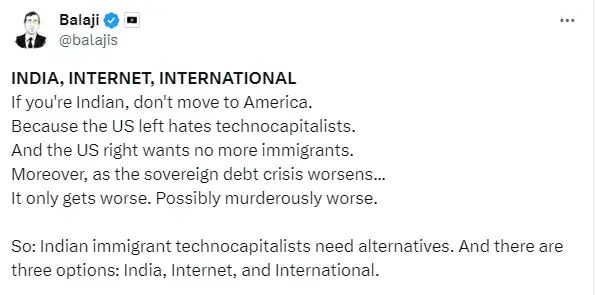
No one is asking you to limit your dreams and ambitions. But as I noted in the beginning, so many people succumb to inaction because they want to do something international. Something great. If they can do it, great, but if it doesn’t happen, then internet is a good entry point. It takes you places, even international.
And above all, you can just do things on the internet.
Your first dollar online changes your outlook
Speaking of internet… Several years back, I had read this statement somewhere on the social media: “your first dollar online changes your outlook.”
I didn’t know at the time that it will get engraved on my brain tissues and never leave me. Because when I indeed made my first dollar online, it changed something inside me.
It was this Data System Design handbook. I think somewhere around late 2022, I was feeling a strong urge to share my ideas on creating data system, from operational point of view. So, I typed out the mini-handbook and put up on Gumroad. Again, internet. It just lets you do things.
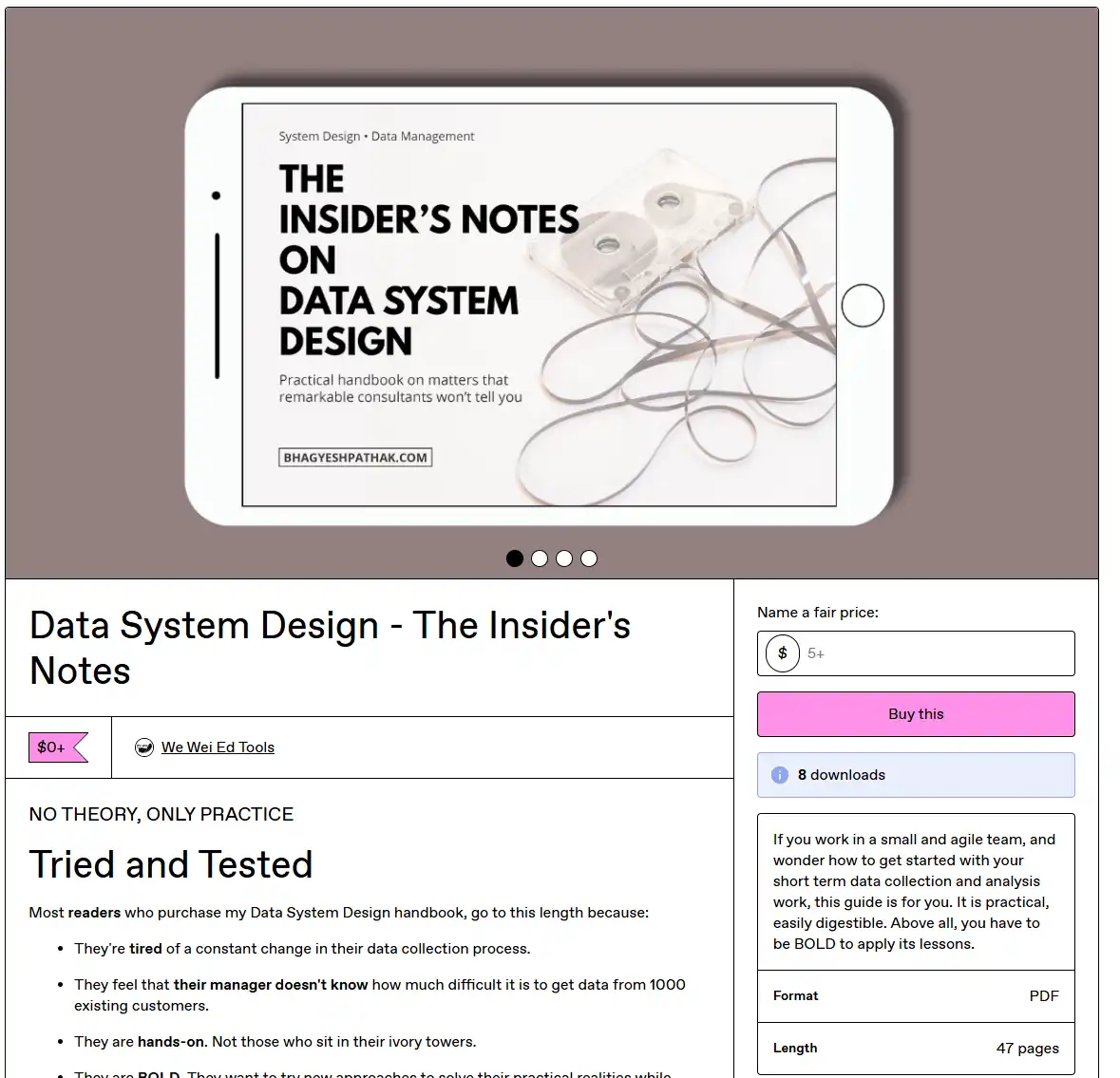
And shortly, somebody paid $1 to buy this. And if I remember correctly, it was somebody from Czech Republic. 6000 km away from India!
This $1 indeed changed my outlook. I can’t describe it in words but you can feel it in my words and tone. One of the immediate feelings is immense gratitude. You feel grateful for getting recognized for your contribution. For most people–especially men–money is the world’s greatest validation. The world tells you what you’re doing is useful. Money is universal token of appreciation.
There are only 8 downloads of this data system handbook since its launch but you know, the best change of outlook is the beginning of internal-search. The search of your gifts that can be valued higher by the market. The vast internet market.
You can just do things.
Open-source is always open
I’ve been quite late to the open-source party. I was unaware of the secret world of systems that run the world.
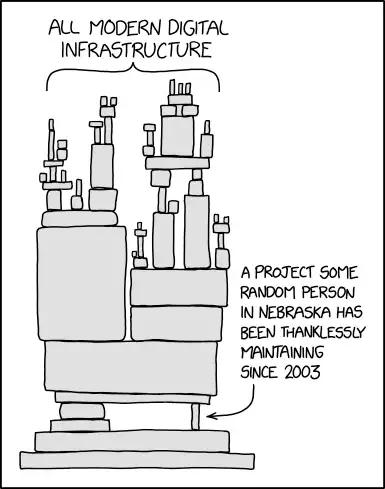
Before I talk more about open-source, let me check one thing with you. If you’re working in non-tech field, and as soon as you read “open-source” in the above paragraph, did you think: “open-source? I’m a non-tech person.” If you did, you need to pay attention.
Most of the projects that we generally talk about under open-source are related to technology. But, that’s not what open-source is about.
Open-source is about collaboration.
Now, “collaboration” sounds like just another bland, over-used, worn out..in Ayn Rand’s language: a corporate bromide. And there’s a reason to it. Much of what we call collaboration is mostly communicating with other people because we work in the same organization or industry.
Open-source collaboration is different and better than that. People sitting 10,000 km away from you see your work or you see their work and suggest improvements or use your work to build something greater based on your ideas. Or let you use their free software for your own usage, without asking for anything in return.
Let me show you what I mean. A few weeks back, I was integrating a payment gateway provider named Dodo Payments for my upcoming product Feedhammer. Some of their installation commands weren’t working as expected. I checked, understood the mistakes in their documentation. Since their documentation is opensource, I suggested the fix in their Github repository. Wthin 5 days, they accepted the change and updated their documentation. A company where I would not qualify for their tech hiring, I could contribute in my small way. All developers depending on their documentation would save countless minutes. Here’s the source:
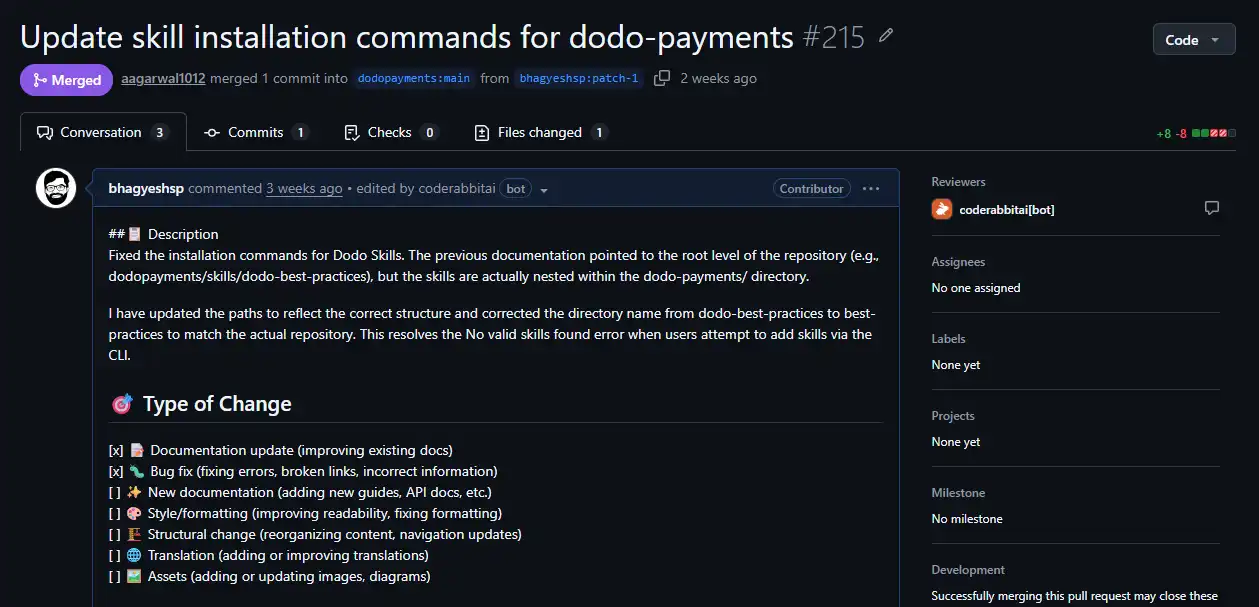
Even if you’re not a programmer, you can contribute to opensource projects. Google or ask your favourite AI tool about contributing to opensource projects as per your skills and interest. It will guide you. Or look into this link and this link.
So, what’s the relevance of opensource with our discussion? It has multiple dimensions:
- We don’t need credentials to contribute.
- We get the feedback of our contribution from the real world: if what you proposed was incorrect or was not matching the expected standard, people will tell you so.
- We can’t fake our contributions. They have history and receipts.
In one sentence, you can just do things.
Take a lever long enough
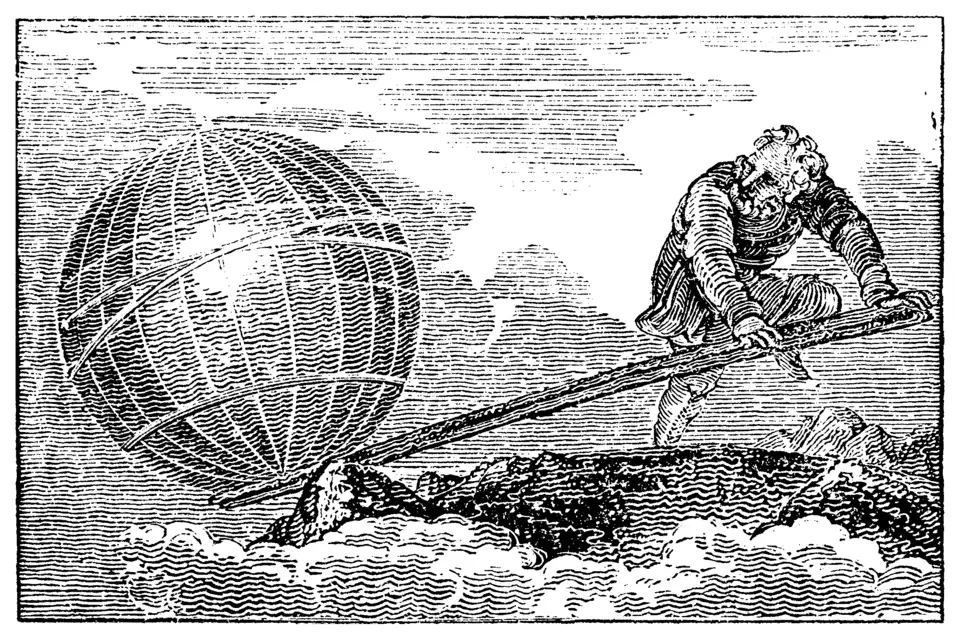
“Give me a lever long enough and a fulcrum on which to place it, and I shall move the world.”
Sometimes I think, if 2000 years back, people had found a lever and fulcrum for him, Archimedes would have moved the Earth. I have no doubt about it. He was just the kind of a guy who just used to do things.
We are not Archimedes and we don’t need to wait for someone to hand us a lever. We have AI, internet, computer and above all, more information than we can process in our life time.
Naval Ravikant has beautifully explained Leverage in this interview. That webpage has mentioned “leverage” 132 times. Because there’s a reason: leverage is everything for a man who just wants to do things.
Though Naval’s discussion and philosophy stems from his background in Economics and startup ecosystem, your leverage doesn’t have to be code, capital or media as he mentions. It can be just your connection and the care with which you take care of your customers.
You can’t build your leverage without going a bit off-track. Without tinkering with ideas and different types of work. The sure-shot way of finding and building your leverage is simple: just do things. The more things you do, the closer you get to identifying areas and building your leverage.
Once you have built a long enough leverage, find a fulcrum to place it on and move the earth.
You can just do things to build leverage.
Pascal’s wager
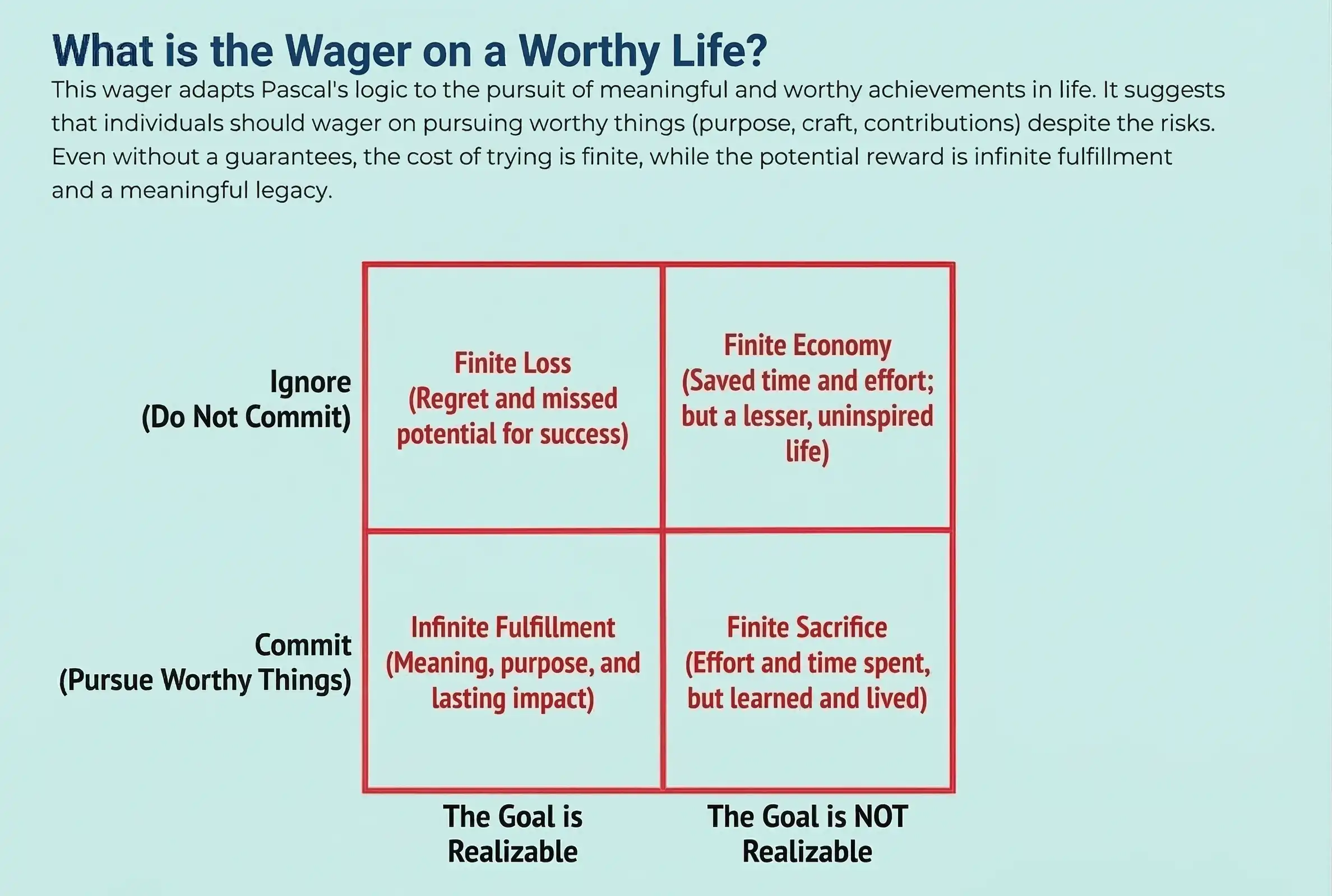
I think about life in terms of a series of decisions. Choices if you like. And some philosophical tools make it easy to make decisions. One such tool is Pascal’s wager.
Approximately 400 years ago, Blaise Pascal shared his thinking about belief in god in a series of statements, ultimately concluding it was a better bet to believe in god than not believing. And now we can use his thinking as a philosophical tool.
I got the following image made using Google’s Gemini. The point is simple, there is so much to gain by committing to things and so little to lose if those things don’t work out.
All these 2000 words to tell you:
You can just do things.
You can just give your gifts.
Receive new articles in your inbox
Can't see the newsletter form? Click here